Toon Buddingh runs investment in early-stage startups and user-experience research for public-sector tools. Fireflies changed what he could capture in an interview — not just how fast he writes it up.
Toon Buddingh is an innovation specialist at Urenbank, a private investment fund for very early-stage startups based in the Netherlands. He's also running user-experience interviews for an active project: a tool that helps Dutch municipalities manage overnight stays. Across both, his week is built around interviews — eight one-to-ones with municipal innovation managers, plus a steady stream of UX research calls.
Before Fireflies, every interview ended the same way. He'd open a paper notebook and spend about 15 minutes writing out a summary and to-dos. That was two hours a week before he even started turning research into action. To turn a stack of UX interviews into a development plan, he needed to reconstruct what each interviewee said, group it by theme, and synthesize it into something engineers could build from. That took weeks.
There was a second cost during the interviews themselves. To make sure he covered his 10 standard questions in every call, he had to keep one eye on his script while talking. That kept the conversation polite but mechanical — and made it harder to ask the follow-up question that would have actually been interesting.
A different way to run an interview
Fireflies now joins every one of Toon's interviews. The transcripts and summaries are the foundation, but the shift Toon talks about most isn't about saving time after the call. It's about what he can do during the call now that he isn't managing a script.
He still has his 10 standard questions. But instead of working through them in order during the conversation, he lets the meeting flow naturally. If the discussion is going somewhere useful, he follows it. Once the call is over, he uses AskFred — Fireflies' conversational Q&A over transcripts — to pull the exact answers to each of his 10 questions back immediately.
The bigger unlock came when he realized something else was getting captured along the way:
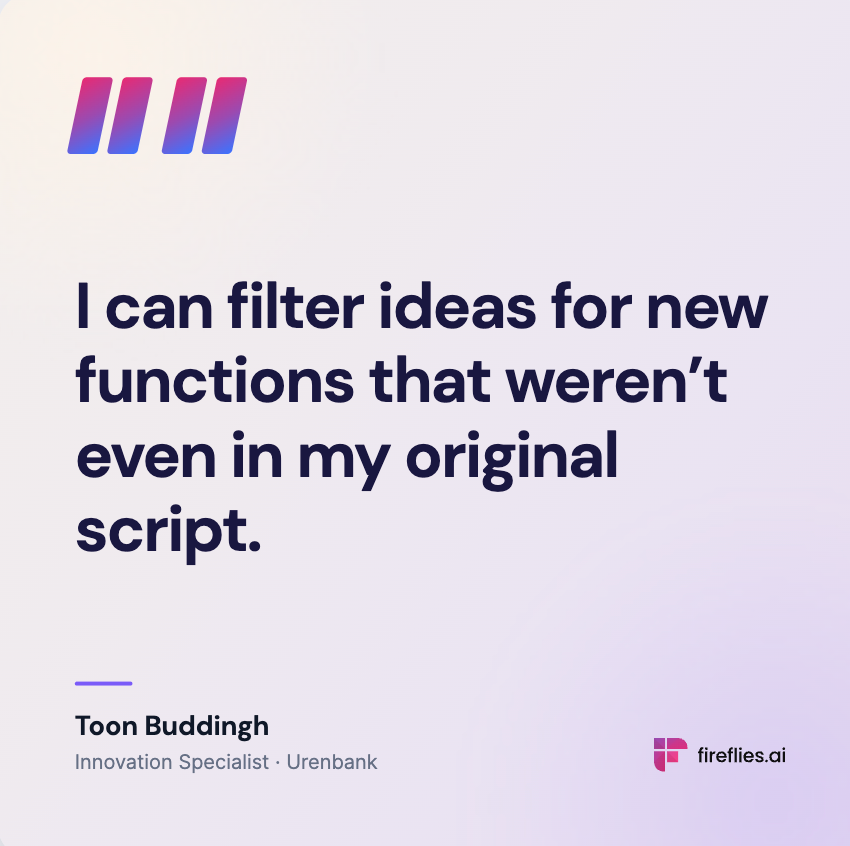
I can talk openly and stay engaged without a script. Afterwards I can filter all the right answers from the transcripts - and I can also filter ideas for new functions in the tool that weren't in my original script.
That's the part most meeting AI tools can't articulate. Toon isn't just retrieving what he asked. He's surfacing what he didn't think to ask.
How weeks of UX research synthesis became a day's work
Both kinds of insight feed straight into his project's development plan. The work that used to take weeks now takes less than a day.
The weekly report to management saw a similar shift. What used to take Toon half a day of reconstruction takes about half an hour now, with a human verification pass included.
By the numbers:
- Development plan from UX research: weeks → less than a day (via AskFred + downstream AI synthesis)
- Weekly reporting time: half a day → ~30 minutes (via AI summaries + AskFred extraction, with human verification)
- Post-meeting note time: ~2 hours/week of handwriting → ~50 min/week reading AI summaries (via auto-transcription + AI summaries)
- Interview cadence: 8 one-to-ones per week, plus UX research interviews
Why it matters
Most AI meeting tools sell themselves as time-savers: they remove the work after the call. Toon's story points to something bigger. When you trust the transcript, you stop steering the conversation around your script — and your research starts surfacing things you didn't think to ask about. The scripted answers still get captured. So do the unscripted product ideas. Both feed straight into the development plan, and it comes together fast.
For anyone who runs research interviews — UX, product, customer success, recruiting, policy — that's the real unlock. Not faster notes. Different research.
Now I can focus on the person I speak to and not on the text that I want to receive.
— Toon Buddingh, Innovation Specialist, Urenbank
Want to run interviews like this? Try Fireflies for free at fireflies.ai.