
ChatGPT has gone from a chatbot you paste transcripts into to a tool that can now record meetings directly. In 2023, using ChatGPT for meetings meant copying a ChatGPT meeting transcript, pasting it into a chat window, and asking for a ChatGPT meeting summary.
In 2026, ChatGPT Record captures audio natively and generates structured output without a separate recording tool.
That changes the comparison entirely.
This article covers three things: how to use ChatGPT for meetings (prompts and workflows that still work), what ChatGPT Record is and where it falls short, and how combining ChatGPT with a dedicated meeting tool like Fireflies gives you the strongest workflow.
Whether you're exploring ChatGPT meeting notes or evaluating whether ChatGPT Record can replace your current stack, this is where to start.
What's Changed: ChatGPT for Meetings in 2026
In 2023, ChatGPT was a text-processing tool. You brought it a transcript, and it helped you summarize, extract Action Items, or draft follow-up emails. It couldn't hear, record, or join anything.
In 2026, OpenAI shipped ChatGPT Record: a native audio recording feature available on ChatGPT Plus ($20/month), Pro, Business, Enterprise, and Edu plans.
Record captures audio from your device, transcribes it using Whisper, and generates an editable Canvas with a summary. The ChatGPT Go plan ($8/month) does not include Record.
This means ChatGPT now competes directly in the meeting AI category. Using OpenAI for meetings is no longer limited to post-meeting text processing. But "competes" doesn't mean "replaces."
The sections below cover where ChatGPT alone works, where Record works, where it falls short, and when a dedicated meeting tool is the better choice.
5 Ways to Use ChatGPT for Meetings
These use cases work whether or not you use ChatGPT Record. They apply any time you have meeting content (a transcript, notes, or a recording summary) and need to turn it into something useful.
1. Generate meeting agendas
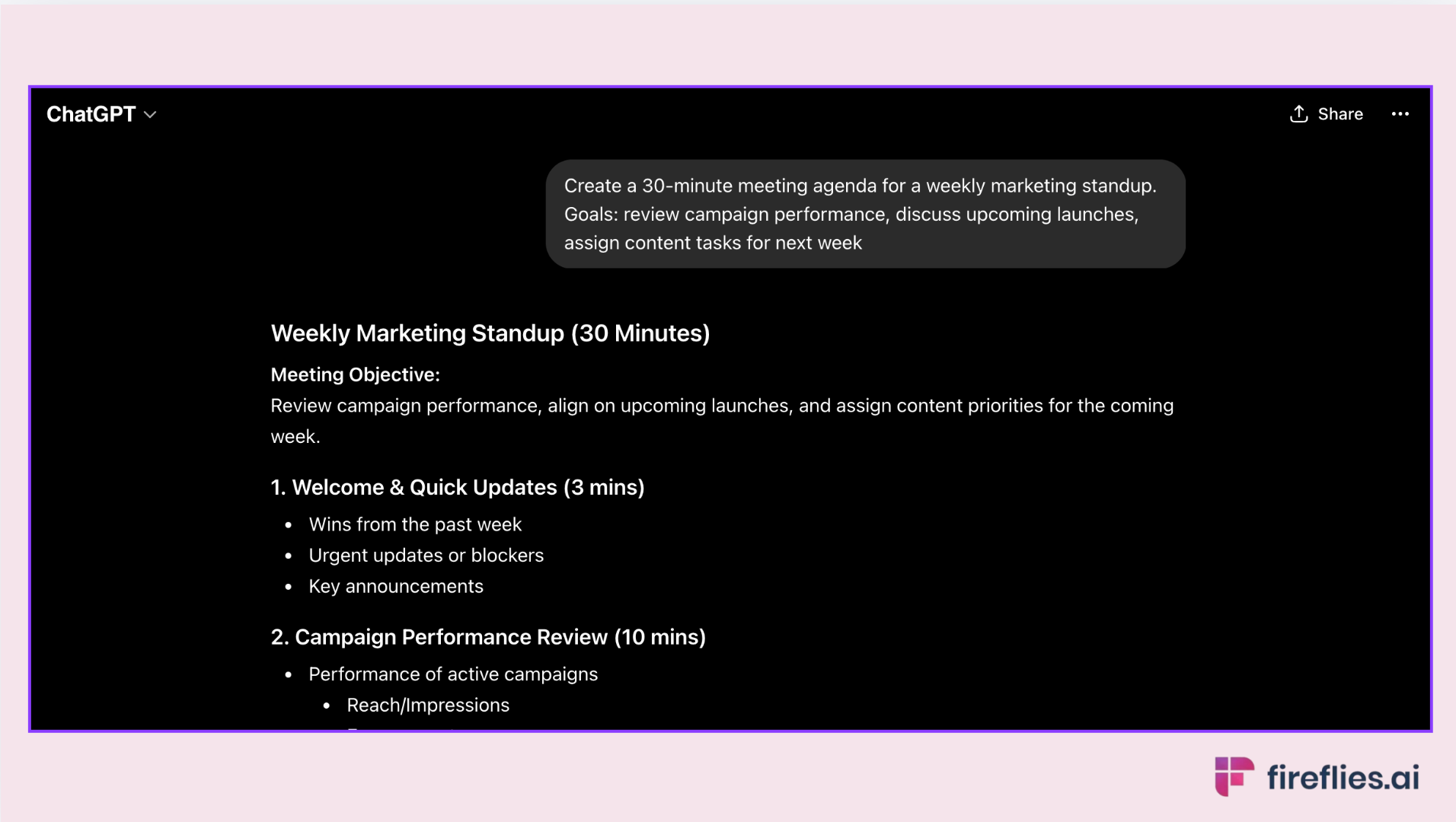
Feed ChatGPT your meeting topic and goals, and it produces a structured ChatGPT agenda in seconds.
Prompt: "Create a 30-minute meeting agenda for a weekly marketing standup. Goals: review campaign performance, discuss upcoming launches, assign content tasks for next week."
2. Summarize meeting transcripts
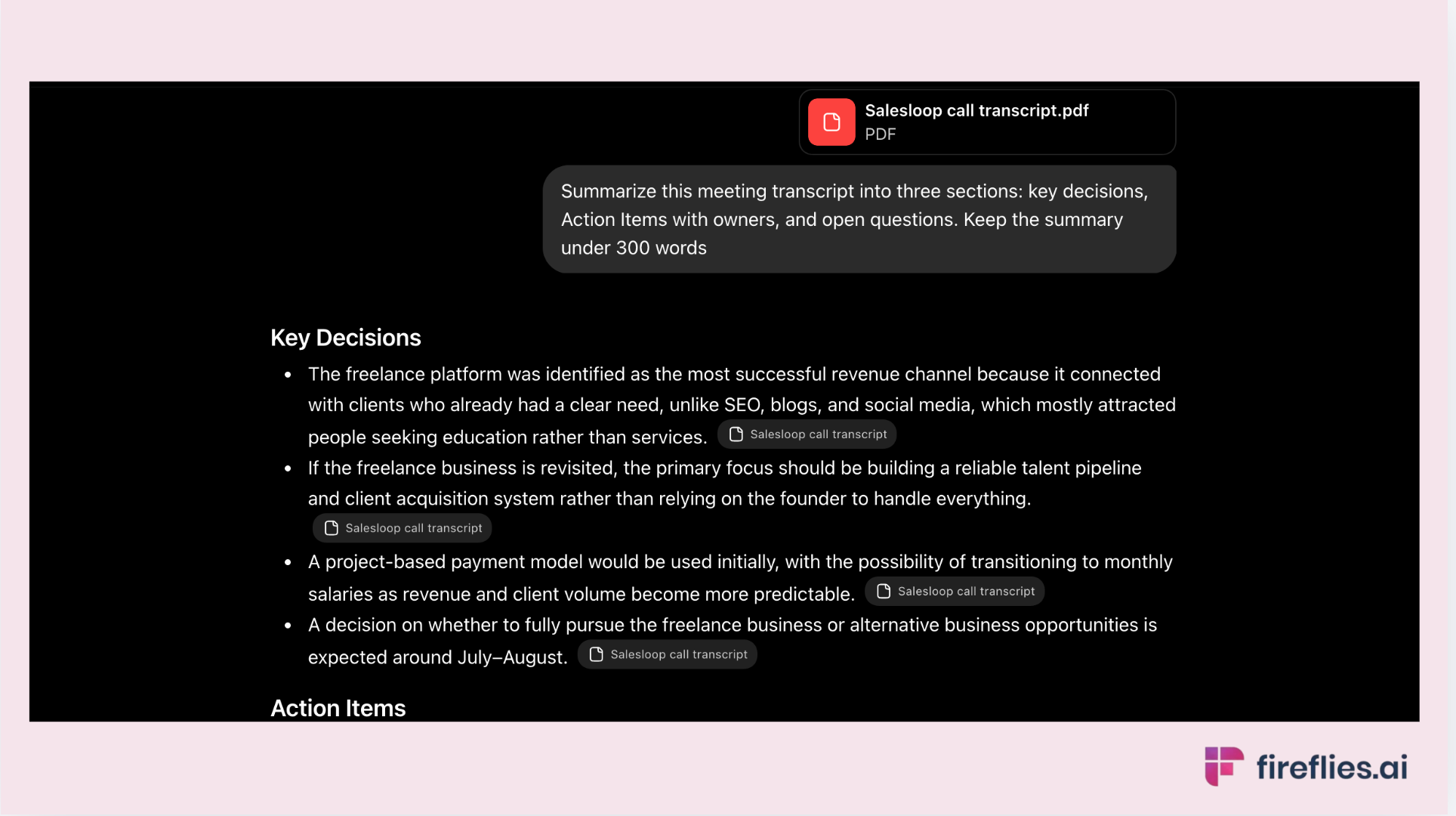
Paste a full transcript and get a structured summary. ChatGPT now handles long-context inputs, so the 2023 limitation of failing on transcripts over 3,000 words no longer applies.
Prompt: "Summarize this meeting transcript into three sections: key decisions, Action Items with owners, and open questions. Keep the summary under 300 words."
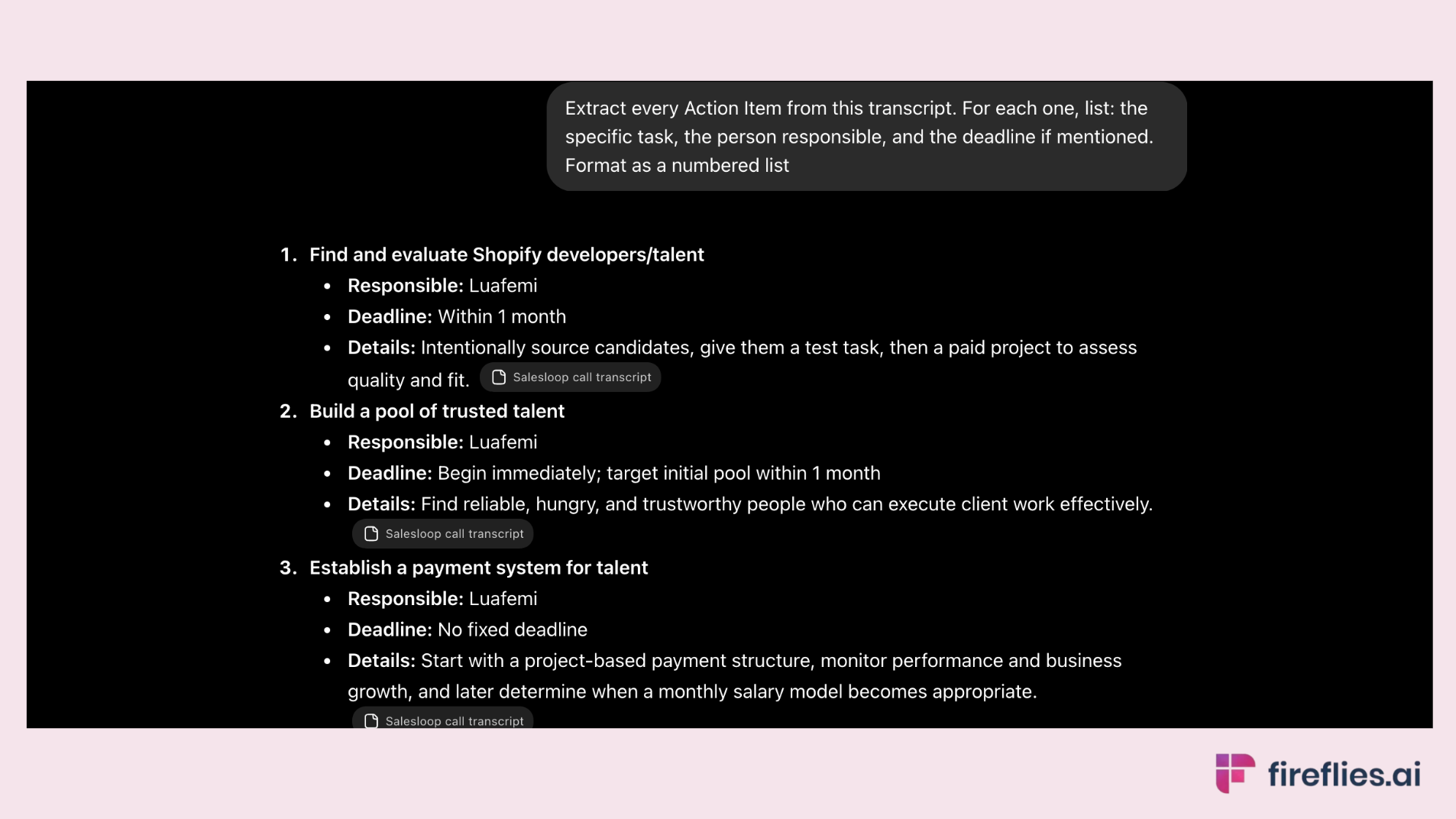
3. Extract Action Items and decisions
Turn a wall of meeting notes into a clean, assignable task list.
Prompt: "Extract every Action Item from this transcript. For each one, list: the specific task, the person responsible, and the deadline if mentioned. Format as a numbered list."
4. Draft follow-up emails
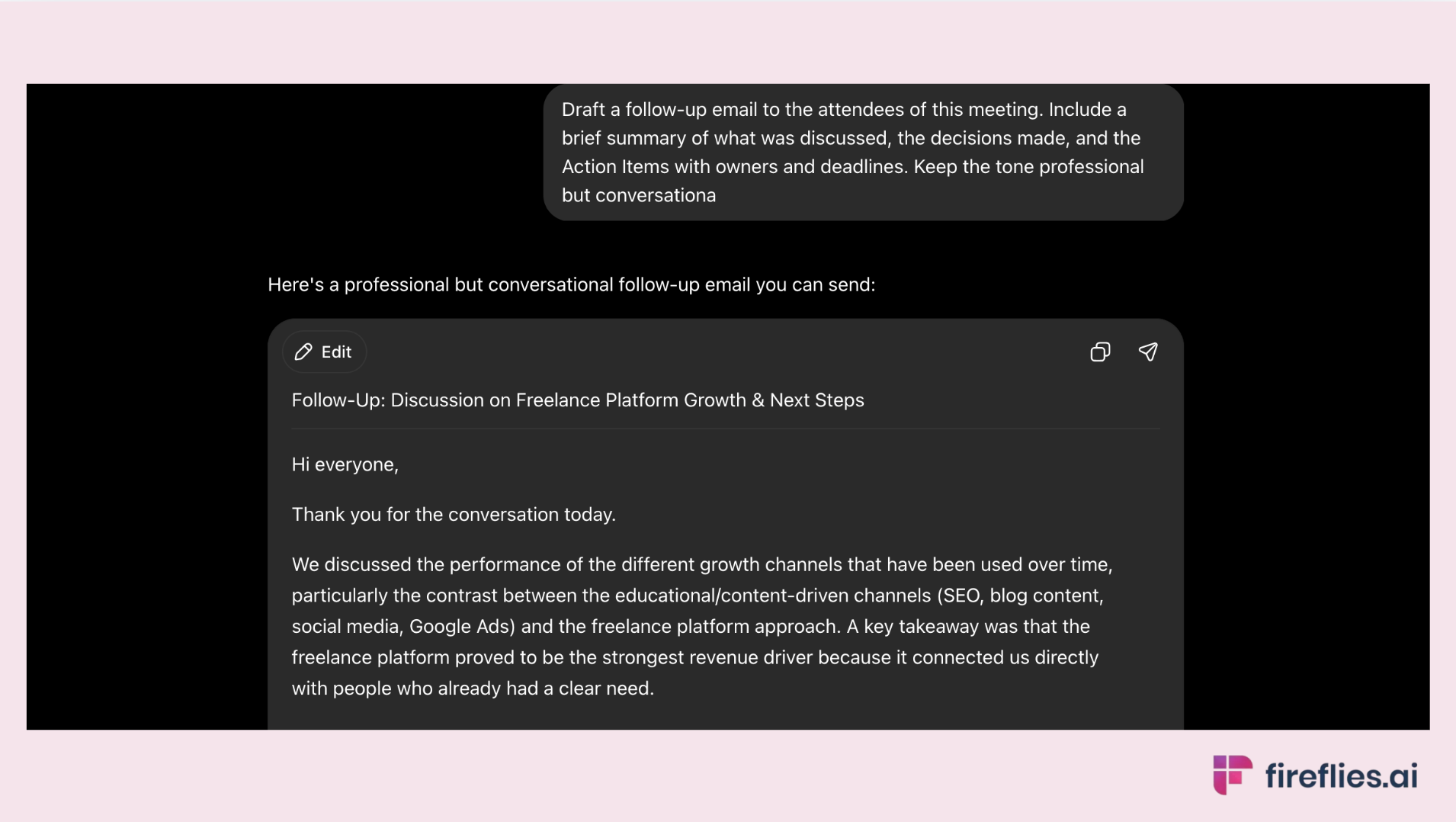
Generate a ready-to-send recap email from your meeting notes or transcript.
Prompt: "Draft a follow-up email to the attendees of this meeting. Include a brief summary of what was discussed, the decisions made, and the Action Items with owners and deadlines. Keep the tone professional but conversational."
5. Analyze sentiment or talking patterns
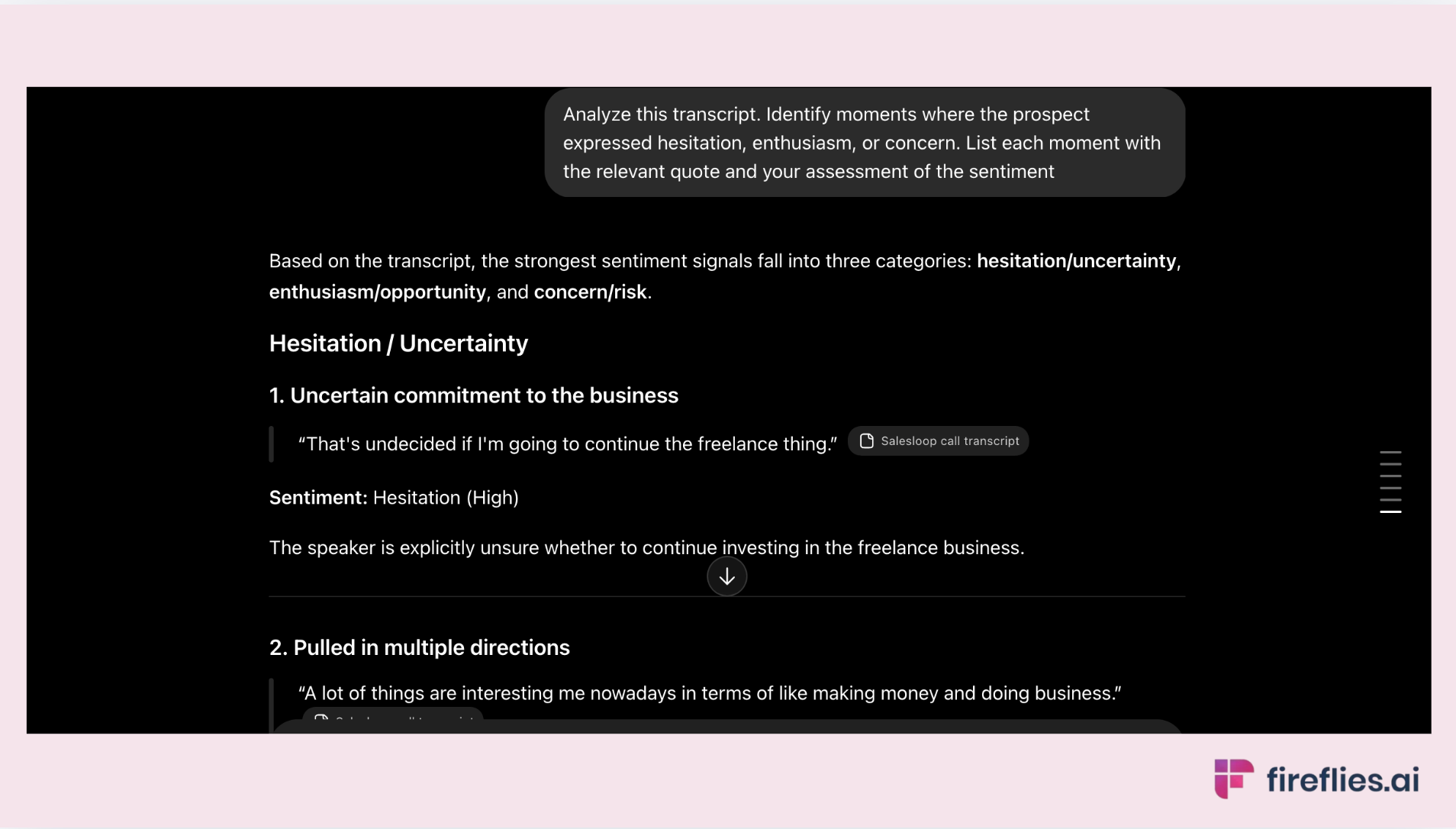
Useful for sales teams reviewing prospect calls or managers coaching their reports. This is where the ai meeting assistant ChatGPT workflow gets especially powerful.
Prompt: "Analyze this sales call transcript. Identify moments where the prospect expressed hesitation, enthusiasm, or concern. List each moment with the relevant quote and your assessment of the sentiment."
ChatGPT Prompts for Meetings (Copy-Paste Library)
Ten prompts you can drop directly into ChatGPT.
Each one targets a specific meeting task. This is also useful if you're looking for ChatGPT prompts for meeting minutes or more structured output.
Meeting agenda generator: "Create a structured meeting agenda for [meeting type] lasting [duration]. Goals: [list goals]. Include time allocations for each section."
Basic meeting summary: "Summarize this meeting transcript in under 200 words. Focus on what was decided, not what was discussed."
Structured meeting summary (decisions / Action Items / open questions): "Summarize this transcript into three sections: (1) Decisions made, (2) Action Items with owner and deadline for each, (3) Open questions or unresolved issues. Use bullet points."
Action Item extractor: "Extract every Action Item from this transcript. Format each as: [Task] - [Owner] - [Deadline]. If no deadline was mentioned, write 'TBD'."
Follow-up email drafter: "Write a follow-up email summarizing this meeting for all attendees. Include key decisions, Action Items, and the date of the next meeting. Keep it under 250 words."
Recap for absent attendees: "Write a brief recap of this meeting for someone who couldn't attend. Include enough context for them to understand the decisions and know their Action Items. Keep it under 200 words."
Sales call discovery summary: "Summarize this sales discovery call. Include: prospect's current situation, pain points mentioned, budget signals, decision-maker identified, objections raised, and agreed next steps."
1:1 meeting notes structuring: "Organize these raw 1:1 meeting notes into sections: Updates, Feedback, Action Items, and Career Development. Clean up the language but preserve the meaning."
Decision log entry: "From this transcript, extract every decision made. For each, list: the decision, who made it, the context (one sentence), and any conditions or dependencies."
Q&A extractor (for webinars or all-hands): "Extract every question asked during this meeting and the answer given. Format as Q&A pairs. If a question wasn't answered, note it as 'Unanswered - needs follow-up'."
Want to skip the prompt-engineering step entirely? AskFred answers questions about your meetings natively.
What Is ChatGPT Record?
ChatGPT Record is OpenAI's native audio recording feature, available on ChatGPT Plus ($20/month), Pro, Business, Enterprise, and Edu plans. It launched in 2025 and works exclusively on the macOS desktop app. Record is not available on iOS or Android.
How ChatGPT Record works
- Open ChatGPT on the macOS desktop app.
- Start a new chat or open an existing one.
- Tap the Record button to begin capturing audio from your device.
- Speak or let the meeting audio play through your device.
- Stop recording when the meeting or segment ends.
- ChatGPT transcribes the audio using Whisper and generates an editable Canvas with a summary.
The output is a freeform Canvas document. You can edit it, ask ChatGPT to restructure it, or prompt for specific extractions (Action Items, decisions, follow-ups).
What ChatGPT Record captures
Record produces a transcript and a summary Canvas. You can prompt ChatGPT to extract specific elements: Action Items, decisions, sentiment analysis. The quality is solid for clear audio with one or two speakers.
Speaker identification is partial. ChatGPT Record supports generic Speaker 1/Speaker 2 labels that you can manually rename, but it does not auto-identify speakers the way dedicated meeting tools do.
Where ChatGPT Record falls short
Limited meeting platform integration. ChatGPT Record can sync with Google Calendar and auto-join scheduled Google Meet meetings, which makes it more useful for teams already in Google Workspace. However, it does not offer bot-style auto-join for Zoom, Microsoft Teams, Webex, or other platforms. For non-Google Meet calls, you must start Record manually in the macOS app. If you forget, the meeting isn't captured.
No workflow integrations. There's no way to push the output to Salesforce, HubSpot, Slack, Notion, or any other tool. The Canvas lives inside your ChatGPT chat history.
No automation. No auto-extracted Action Items with owners. No CRM field filling. No Slack distribution. Everything requires manual prompting and copy-pasting.
macOS only. Record mode is not available on iOS, Android, or Windows. If your team uses mixed devices, some members simply can't use it.
Limited compliance. OpenAI is SOC 2 certified for Business and Enterprise tiers. HIPAA support is only available via ChatGPT for Healthcare with an Enterprise BAA. No private cloud storage option. Data is retained for 30 days after chat deletion. OpenAI excludes Business and Enterprise accounts from model training, but individual Plus accounts have different terms.
ChatGPT Record vs. Fireflies: Comparison
The verdict: ChatGPT Record is convenient for individual users who already pay for ChatGPT and want a quick recording without installing another tool.
Fireflies is the better choice for teams that need automatic meeting capture, CRM and Slack integrations, multi-speaker identification, compliance certifications, and automation across multiple meetings.
The Strongest Workflow: Fireflies + ChatGPT Together
For many teams, the most productive setup isn't one or the other. It's both.
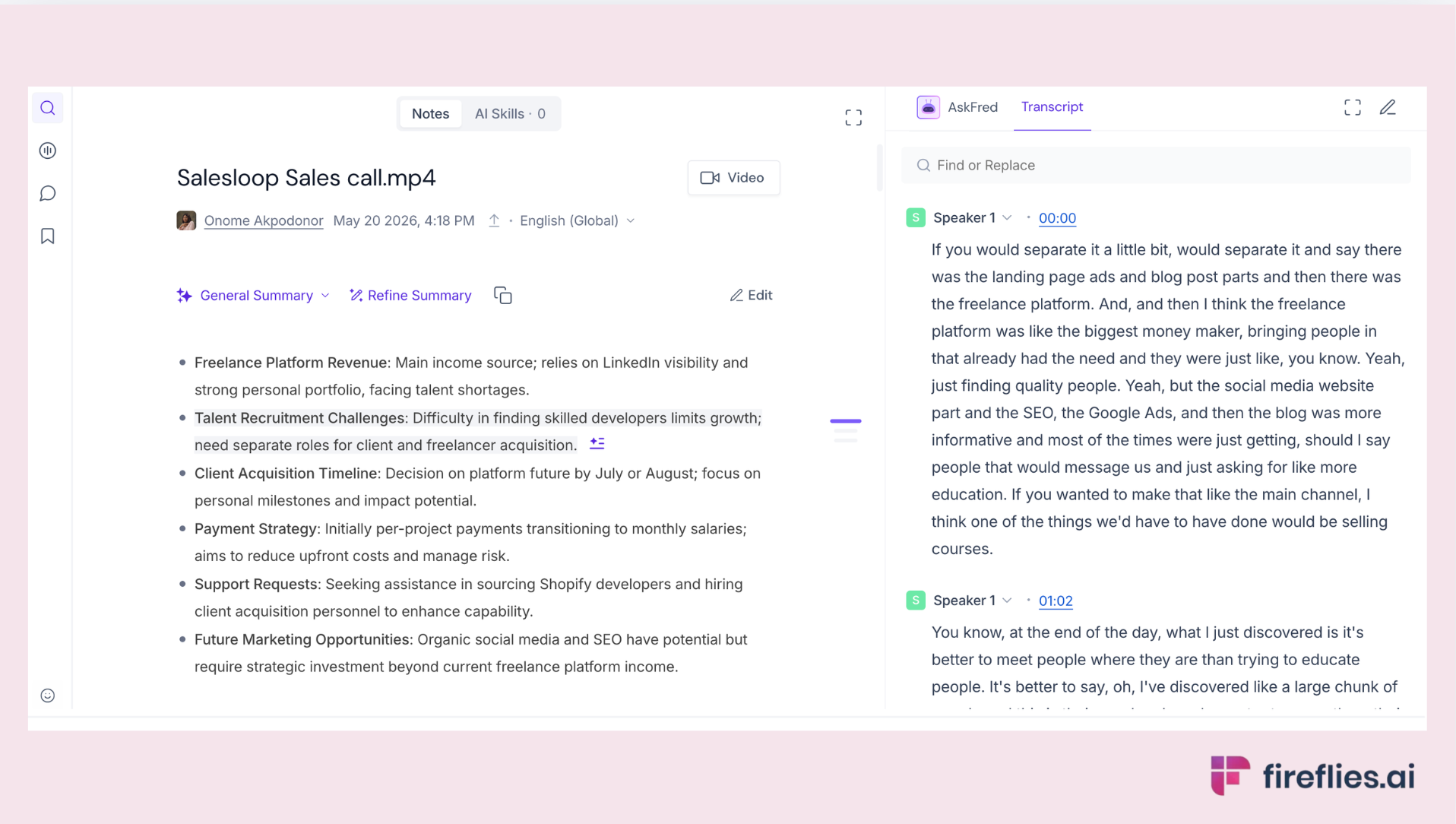
Step 1: Fireflies records and transcribes the meeting
Fireflies auto-joins via calendar sync, captures every speaker with automatic identification, and delivers a structured summary with Action Items, decisions, and topics. The transcript, summary, and recording are available in your dashboard within minutes.
Step 2: Export the transcript from Fireflies
Copy the transcript or summary from Fireflies and paste it into ChatGPT for tasks that require creative writing output: drafting a client-facing summary, turning meeting insights into a blog post, refining a pitch based on prospect feedback, or writing a detailed project brief.
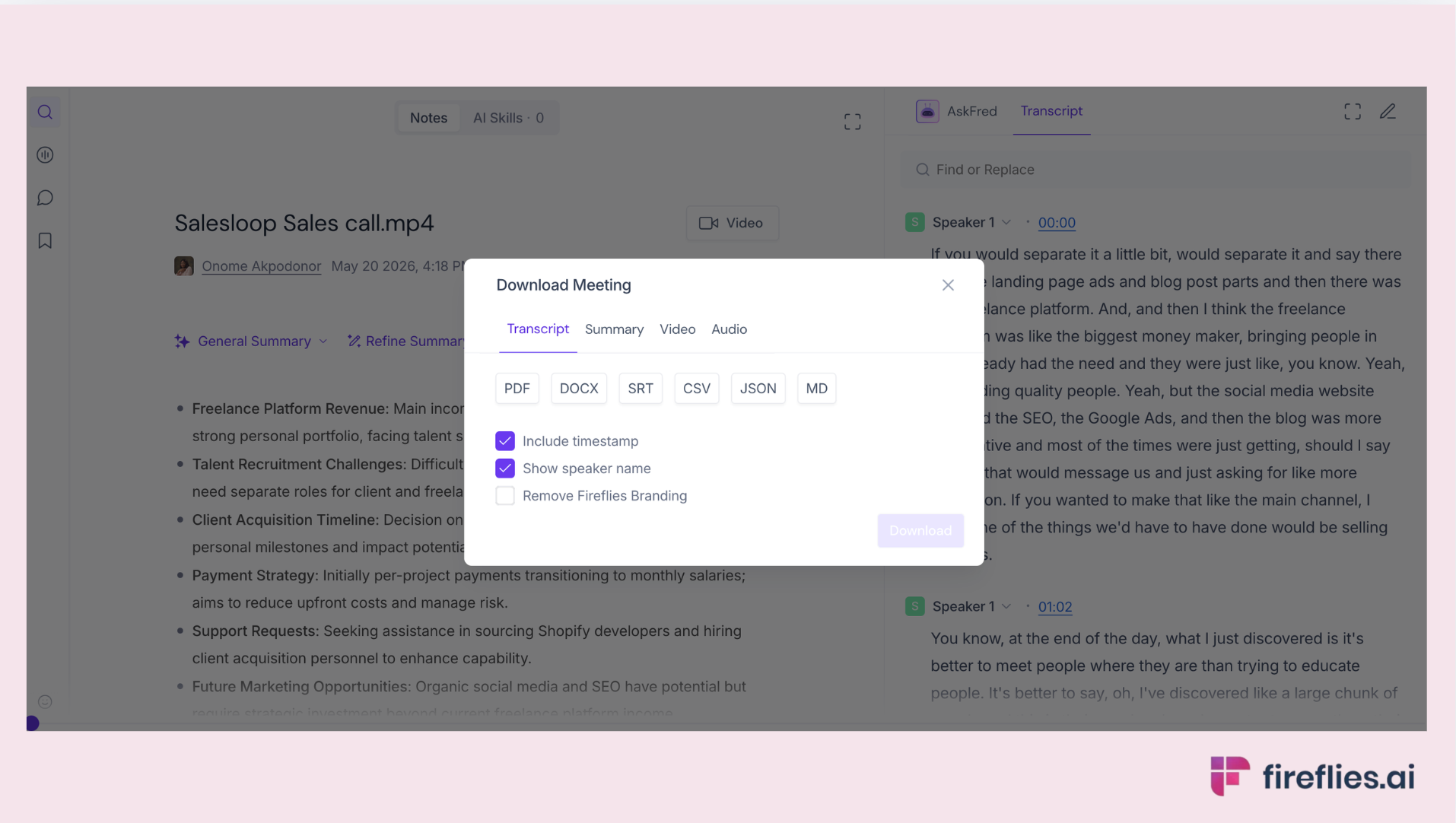
Step 3: Use ChatGPT for the creative writing tasks
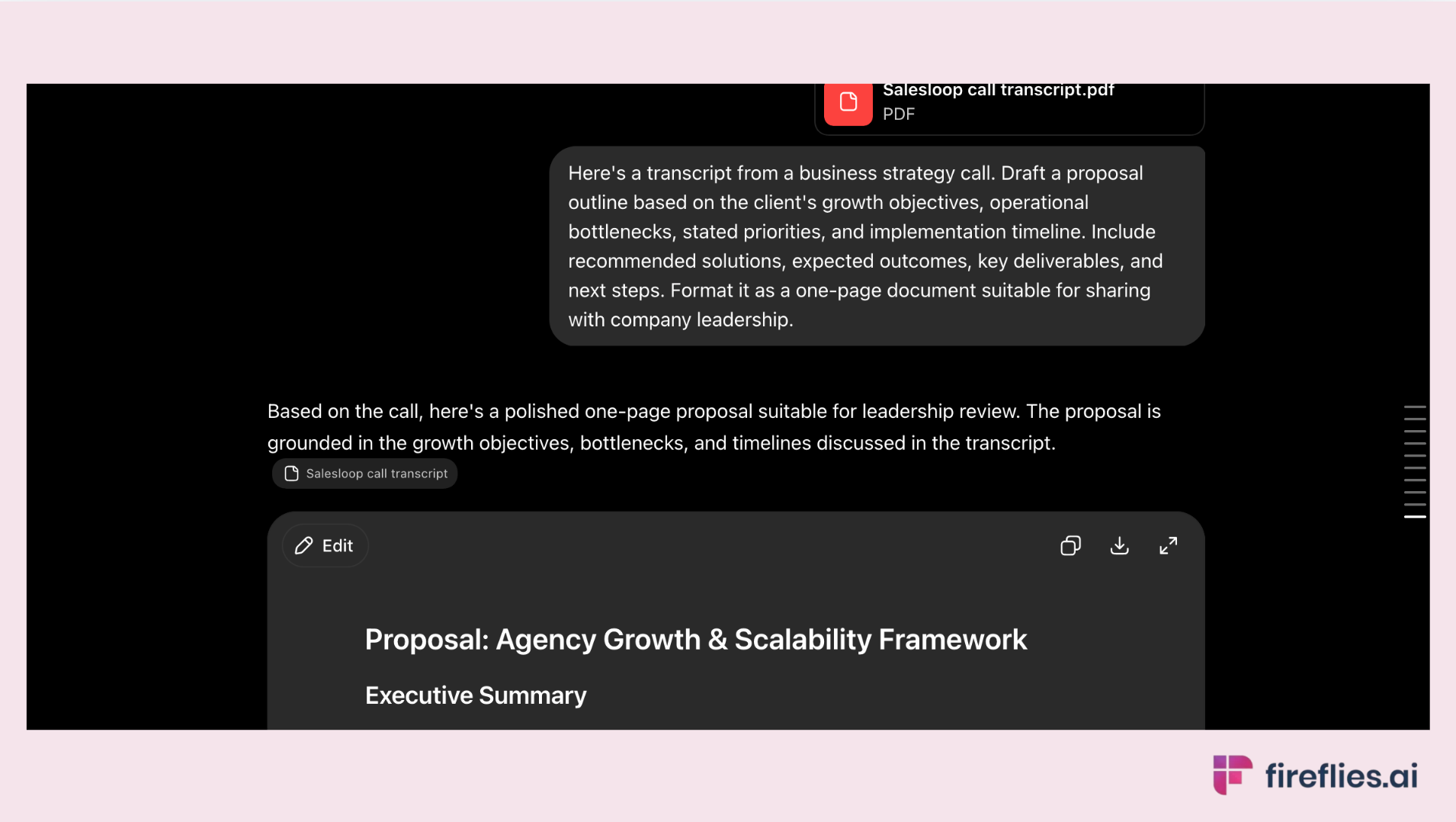
ChatGPT excels at transforming structured meeting data into polished output for external audiences. A Fireflies transcript gives ChatGPT the raw material. ChatGPT turns it into the deliverable.
Example prompt: "Here's a transcript from a business strategy call. Draft a proposal outline based on the client's growth objectives, operational bottlenecks, stated priorities, and implementation timeline. Include recommended solutions, expected outcomes, key deliverables, and next steps. Format it as a one-page document suitable for sharing with company leadership."
Or skip the manual step: use AskFred
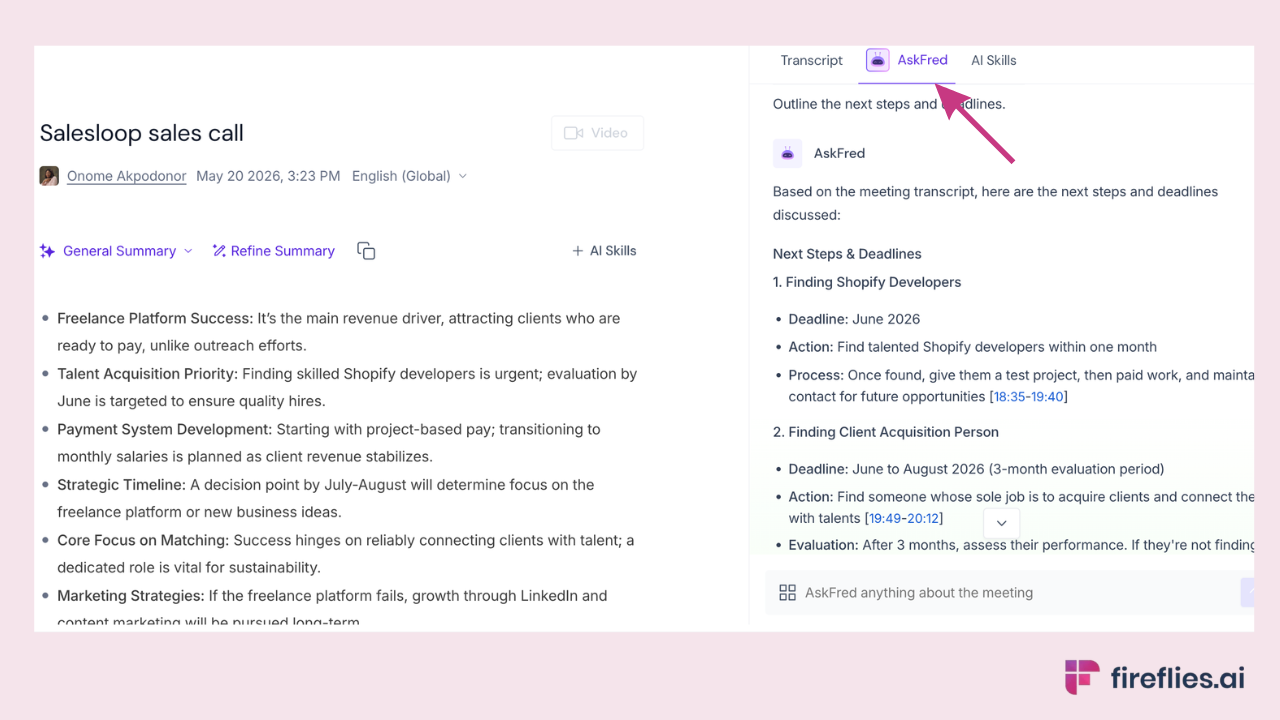
If you don't need creative writing output and just want to query your meetings, AskFred handles it natively inside Fireflies.
Ask "What did the client say about pricing?" or "Outline the next steps and deadlines" and get grounded answers with citations from your actual meeting data.
AI Skills automate the repeated workflows: push Action Items to Slack, fill CRM fields, generate meeting recap emails, and create tasks in Asana or Jira. No prompting required.
Fireflies also integrates with ChatGPT and Claude via MCP connectors, letting you query your meeting history directly from inside ChatGPT or Claude without exporting anything.
When to Use ChatGPT vs. When to Use a Dedicated Meeting Tool
Use ChatGPT alone if: You have occasional meetings, your primary need is writing-heavy creative output (proposals, blog posts, client summaries), and you don't need meeting platform integrations or CRM sync. ChatGPT for meeting minutes works well when you already have the transcript.
Use ChatGPT Record if: You want simple meeting recording for personal use, you're already paying for ChatGPT Plus or above, you use a Mac, and you have low integration needs.
Use Fireflies if: You have regular meetings across Zoom, Google Meet, or Teams, need CRM and Slack integrations, work in multiple languages, have compliance requirements (SOC 2, HIPAA, FERPA), or want automation across multiple meetings without manual prompting.
Use both together if: You want structured meeting capture with automatic integrations (Fireflies) plus advanced creative writing output for external-facing deliverables (ChatGPT).
FAQs
Can ChatGPT take meeting notes?
Yes, in two ways. You can paste a meeting transcript into ChatGPT and prompt it to extract notes, summaries, and Action Items. Or you can use ChatGPT Record (Plus plan and above, macOS only) to capture audio directly and generate a summary Canvas. Neither method auto-joins meetings or integrates with CRM and project management tools the way dedicated meeting AI does.
Can ChatGPT join a meeting?
Partially. ChatGPT Record can sync with Google Calendar and auto-join Google Meet calls. It does not join Zoom, Microsoft Teams, Webex, or other platforms. For non-Google Meet meetings, you must start Record manually on the macOS desktop app. Fireflies auto-joins across all major platforms via calendar sync..
Is ChatGPT Record free?
No. ChatGPT Record is available on ChatGPT Plus ($20/month), Pro, Business, Enterprise, and Edu plans. The free ChatGPT plan and the ChatGPT Go plan ($8/month) do not include Record. Fireflies offers a free plan with unlimited transcription and 400 minutes of meeting storage per team.
Can ChatGPT transcribe audio?
Yes. ChatGPT Record uses OpenAI's Whisper model to transcribe audio. It supports 99 languages, though accuracy varies significantly by language. For English, accuracy is strong. For less common languages, quality can drop. Fireflies supports 100+ languages with 99% accuracy for English and 95% for other languages.
What's the best ChatGPT prompt for a meeting summary?
"Summarize this transcript into three sections: (1) Decisions made, (2) Action Items with owner and deadline for each, (3) Open questions or unresolved issues. Use bullet points. Keep the total summary under 300 words." This structured prompt produces the most useful output for most meeting types.
Should I use ChatGPT or Fireflies for meetings?
It depends on your workflow. ChatGPT is excellent for writing tasks: drafting proposals, generating follow-up emails, and turning meeting insights into content. Fireflies is built for meeting capture and automation: it auto-joins calls, identifies speakers, extracts Action Items, fills CRM fields, and distributes recaps automatically. Many teams use both: Fireflies for structured capture and integration, ChatGPT for creative output.
How do I summarize long meetings with ChatGPT?
ChatGPT now handles long-context inputs, so you can paste full meeting transcripts without hitting the character limits that existed in 2023. For best results, use a structured prompt that specifies the output format you want (decisions, Action Items, open questions). If the transcript is very long (over 60 minutes of content), consider breaking it into logical sections and summarizing each separately, then asking ChatGPT to merge the summaries.
Conclusion
ChatGPT is no longer just a chatbot you paste transcripts into. With Record, it can capture meetings directly. With long-context support and strong prompting, it handles ChatGPT meeting summary generation, Action Item extraction, and follow-up drafting better than ever.
But ChatGPT Record is a personal recording tool, not a meeting platform integration. It doesn't auto-join calls, doesn't identify speakers automatically, doesn't push output to your CRM or Slack, and doesn't work on mobile or Windows.
For teams that need consistent, automated meeting capture with workflow integrations, Fireflies handles that layer.
The strongest workflow for many teams is both: Fireflies for structured capture, AI meeting notes, and automation; ChatGPT for creative writing output and ad-hoc analysis. Start with Fireflies as your meeting foundation and add ChatGPT where writing quality matters most.

![Fathom AI Notetaker: An Honest Review + 6 Better Alternatives [2026]](https://storage.ghost.io/c/18/b5/18b50ec6-aaa0-4f89-82bd-97facf43831a/content/images/size/w1000/2023/04/Screenshot-2023-04-12-at-5.23.15-PM.png)