![10 Best Note-Taking Apps For Chromebook [Free And Paid]](/_next/image?url=%2Fapi%2Fblog-media%2Ffile%2FMeeting-etiquette-rules-all-professionals-must-follow-4.png%3Fprefix%3Dpayload%252Fblog&w=3840&q=75)
Discover the top 10 note-taking apps for Chromebooks! Explore features, pricing, and user reviews to find the perfect app for your needs.
On this page
- Does Chromebook Have a Built-In Notes App?
- The Best Note-Taking Apps for Chromebook, by Use Case
- Category 1: Best Quick Capture Note-Taking Apps for Chromebook
- Google Keep (Best for fast, frictionless notes)
- Simplenote (Best for plain text and minimalists)
- Category 2: Best Structured and Research-Friendly Note-Taking Apps for Chromebook
- Notion (Best for wikis, databases, and team notes)
- UpNote (Best for research and document organization)
- Microsoft OneNote (Best for Microsoft 365 users)
- Category 3: Best Handwriting Note-Taking Apps for Chromebook
- Squid (Best for handwritten notes on touchscreen Chromebooks)
- Noteshelf (Best for rich handwriting and PDF annotation)
- Category 4: Best Note-Taking Apps for Chromebook for Privacy-Focused and Power Users
- Obsidian (Best for linked thinking and knowledge graphs)
- Joplin (Best for open-source, privacy-first notes)
- Category 5: Best Meeting Notes App for Chromebook
- Fireflies.ai (Best for automatic meeting transcription and notes)
- Quick View: Chromebook Note-Taking Apps Compared
- Which Note-Taking App Is Right for You?
- FAQs About Note-Taking Apps for Chromebook
Chromebooks are the go-to device for students, educators, and remote workers who want something lightweight, affordable, and built for the web.
Note-taking is one of the most common things people do on a Chromebook. While Google Keep comes pre-installed and works well for quick lists, it does not cover every use case. The moment you need folders, rich formatting, handwriting support, or a way to capture what was said in a meeting, Keep runs out of road.
The right note-taking app depends entirely on what you are trying to do.
This guide organizes the best note-taking apps for Chromebooks into five use-case categories: quick capture, structured notes, handwriting, power users, and meeting notes. Skip to the category that fits your workflow, or read through all ten options before deciding.
Does Chromebook Have a Built-In Notes App?
Yes, most Chromebooks come with Google Keep pre-installed, and it is accessible via browser on any model. It is a solid starting point for quick notes, reminders, and shared lists.
If you have a touchscreen Chromebook with stylus support, you also have access to Cursive. It is a Progressive Web App (PWA) built by Google specifically for Chromebooks, designed for handwritten notes and sketches. You can install it by heading to cursive.apps.chrome and clicking install in the toolbar.
Both apps are free and worth knowing about. But neither covers structured notes, research organization, or meeting transcription. That is exactly why the note-taking apps below exist.
Also Read: 7 Easy Types of Note-Taking Methods For Learners
The Best Note-Taking Apps for Chromebook, by Use Case
Different Chromebook users have different needs. Sometimes you need to capture a thought in two seconds. Sometimes you need to organize a semester's worth of research. Sometimes you just need someone to take notes for you while you focus on the conversation.
The ten note-taking apps below are grouped into five categories. Every app works in the Chrome browser or as an Android app on Chromebook, has an active free plan in 2026, and is still being maintained and updated. Where offline access matters, we have flagged it. Where AI features are locked behind a paywall, we said so.
Pick the category that fits your workflow and start there.
Category 1: Best Quick Capture Note-Taking Apps for Chromebook
If you want a Chromebook notes app that opens instantly and gets out of your way, start here.
Google Keep (Best for fast, frictionless notes)

Best for: Chromebook users who want a free, preinstalled notes app that syncs instantly across all their Google devices.
Google Keep is the most accessible free note-taking app for Chromebooks. It comes pre-installed and is accessible via browser, the Android app on Google Play, or the Chrome extension for web clipping. It syncs in real time across the web, Android, and iOS using your Google account.
It covers more ground than most people expect. Keep supports rich text, checklists, drawing, and voice memos with automatic transcription. On touchscreen Chromebooks, you can draw notes, annotate images, or use handwriting-to-text natively. The Chrome extension lets you clip snippets, URLs, and images directly into your notes while browsing. You can also set reminders by time or location, share notes for real-time collaboration, and organize everything with color coding, labels, and pins.
Keep has two native AI features that work on any free Google account. Snap a photo of a whiteboard or document, and OCR instantly extracts the text, making it searchable. You can record a voice memo and Keep transcribes it automatically, giving you both the audio and a written transcript in the same note. If you want Magic Lists, which builds checklists from a text prompt, you will need a Google AI Pro subscription or a Pixel device. The same goes for full Gemini integration in Keep.
Key features:
- Rich text, checklists, drawing, and voice memos with automatic transcription
- Touch and stylus support for handwriting and image annotation on touchscreen Chromebooks
- Real-time collaboration with shared notes, color coding, labels, and location or time-based reminders
- Free OCR turns photos into searchable text; Magic Lists and Gemini integration available on Google AI Pro ($19.99/month)
Price:
- Free
- Magic Lists and Gemini Workspace integration require Google AI Pro ($19.99/month) or a Pixel device.
Limitations:
- Keep uses labels instead of folders, which works fine for a small collection but becomes harder to manage as your notes grow.
- There is no rich document formatting, making it a poor fit for long-form writing or structured research.
Simplenote (Best for plain text and minimalists)

Best for: Writers, developers, students, and professionals who want a completely free, distraction-free notes app with instant sync on Chromebook.
Simplenote is one of the most popular Google Keep alternatives for Chromebook users who want a cleaner, more focused writing experience. It is built by Automattic, the team behind WordPress, and syncs instantly across web, Android, iOS, Windows, and Linux. It is available on Chromebook via the browser or as an Android app on Google Play.
You get plain text notes with Markdown support. Tags keep things organized, and you can pin important notes to the top of your list for quick access. Version history lets you drag a slider to restore any previous draft. Internal note links let you connect one note to another, making it easy to cross-reference ideas without leaving the app. You can share notes with others for real-time collaboration, or publish any note publicly with its own URL.
The 2026 MCP server update lets you search, create, update, and restore notes directly from AI tools like Claude, all without opening the app.
Key features:
- Markdown support with live preview, tags, pinning, internal note links, and version history
- Real-time collaboration, public note publishing, and note sharing with edit access
- MCP server integration for searching, creating, updating, and restoring notes directly from AI tools like Claude
Price:
- Free for full access, including sync, backups, and Markdown.
- Sustainer plan at $19.99/month or $199.99/year is entirely voluntary and adds no extra features. It exists purely for users who want to support Automattic's development of the app.
Limitations:
- Simplenote is plain text only, with no support for images, attachments, tables, or any rich media.
- The MCP integration requires manual setup and is not available natively within the Chromebook browser experience.
Category 2: Best Structured and Research-Friendly Note-Taking Apps for Chromebook
Quick capture apps are great for getting thoughts out fast. But when you are juggling multiple projects, building a knowledge base, or trying to make sense of weeks of research, you need something that can hold it all together. The three apps in this category give you folders, databases, rich formatting, and the ability to organize information the way your brain works.
Notion (Best for wikis, databases, and team notes)

Best for: Teams and individuals who need wikis, relational databases, and collaborative notes all in one connected workspace.
Notion is available on Chromebooks via the Chrome browser and as an Android app on Google Play. You get a block-based workspace where every piece of content, whether a paragraph, a checklist, an image, or a full relational database, is a block you can move, nest, and connect however you want.
You can build simple notes or entire team wikis from the same interface. Databases let you view the same information as a table, board, calendar, or gallery, depending on what you need. Templates cover everything from class notes and project trackers to company wikis and CRM systems. Notion also integrates with Slack, Google Drive, GitHub, and dozens of other tools.
Notion AI is included in Business and Enterprise plans. It covers AI Meeting Notes, autonomous Agents that execute multi-step tasks, Enterprise Search across connected tools like Slack and Google Drive, database Autofill, and Research Mode. Free and Plus users get only a limited trial.
Key features:
- Block-based pages with multiple database views: table, board, calendar, and gallery
- Real-time collaboration with comments, permissions, and a template library
- Live database sync with external tools via the 2026 Developer Platform
Price:
- Free: Unlimited pages and blocks for individual use, 10 guests, 5MB file uploads, 7-day page history, limited Notion AI trial
- Plus ($12/user/month billed annually): Unlimited guests, 30-day page history, unlimited file uploads, full collaboration features
- Business ($24/user/month billed annually): Everything in Plus, plus SAML SSO, private teamspaces, granular database permissions, 90-day page history, and full Notion AI included
- Enterprise: Custom pricing, adds audit logs, SCIM provisioning, unlimited page history, and advanced compliance controls
Limitations:
- Offline access is limited to the browser version. Pages you have not recently visited are inaccessible without a connection, which can be a real problem on a Chromebook without a desktop app.
- The free plan caps team collaboration at 1,000 blocks when two or more workspace owners are added, which runs out faster than most people expect.
Also Read: Top 7 Note-Taking Tips and Methods For Work
UpNote (Best for research and document organization)

Best for: Writers, researchers, and professionals who want a clean, well-organized notes app with rich formatting and offline access at an affordable price.
UpNote is available on Chromebooks via the Android app on Google Play. You can also access it on iOS, Mac, Windows, and Linux, with everything syncing automatically across all your devices, including offline.
It is built for people who write and research seriously. Use the Focus mode to hide everything except the note you are working on. The editor handles rich text, Markdown, code blocks, images, attachments, and collapsible sections for long notes. When your notes start to grow, the organization holds up. You can separate work into distinct Spaces, nest notebooks inside each other, use hashtags and internal links to cross-reference ideas, and filter notes by keyword to find things fast.
For Chromebook users specifically, the web clipper extension saves any page directly into UpNote from Chrome, and the Sticky Window feature keeps your notes visible on top of other windows during meetings or while watching tutorials.
Key features:
- Complete rich text editor with Markdown, rich text, multiple fonts, and text highlighting in various colors
- Automatic backup and version history so your research and writing is always recoverable
- Templates for quickly creating new notes in a consistent format
- Export to text, PDF, HTML, and Markdown as separate documents or combined into one
Price:
- Free: Up to 50 notes, sync across all devices, basic features
- Premium ($1.99/month or $39.99 lifetime): Unlimited notes, attachments, tables, code blocks, note and notebook locking, elegant themes and notebook covers, export to text, PDF, HTML, and Markdown, automatic backup, and version history
Limitations:
- UpNote has no built-in AI features.
- The free plan is capped at 50 notes, which is enough to evaluate the app but not sufficient for ongoing use.
Microsoft OneNote (Best for Microsoft 365 users)
Best for: Anyone already in the Microsoft ecosystem who wants a free, full-featured notebook that connects directly with Teams, Outlook, and OneDrive.

OneNote on Chromebook is free with a Microsoft account and works in the Chrome browser. You can also install it as a PWA directly from Chrome, which lets you pin it to your taskbar, work offline, and get notifications without opening a browser tab.
OneNote organizes everything into notebooks, sections, and pages, giving you a flexible structure that works for simple notes and complex projects alike. You can combine text, images, handwriting, and sketches freely on the same page, with digital ink that feels natural on touchscreen Chromebooks. The OneNote Web Clipper extension for Chrome saves articles, PDFs, images, and web pages directly into your notebooks. Voice transcription lets you capture notes by speaking, so you can stay focused and review the content later. One standout feature is that Sticky Notes offers quick capture with automatic recall when you revisit the same source.
Copilot Notebooks, available on Microsoft 365 plans, bring AI directly into your workspace. You can add files and emails to a notebook and use Copilot to generate insights, audio overviews, and summaries based on your content.
Key features:
- Freeform canvas combining text, images, handwriting, sketches, and digital ink on the same page
- Voice transcription for capturing notes without typing, with content available to review later
- Copilot Notebooks for AI-powered insights, summaries, and audio overviews based on your files and emails
Price:
- Free: OneNote access with a Microsoft account, 5GB OneDrive storage
- Microsoft 365 Personal ($9.99/month or $99.99/year): OneNote plus Word, Excel, PowerPoint, Outlook, Copilot, and 1TB OneDrive for one person
- Microsoft 365 Family ($12.99/month or $129.99/year): Everything in Personal for up to 6 people, each with 1TB storage
- Microsoft 365 Premium ($19.99/month or $199.99/year): Most powerful individual plan with advanced security and AI features
- Business plans from $7.20/user/month for teams
Limitations:
- Copilot and advanced AI features require a Microsoft 365 subscription and are not available on the free plan.
- OneNote is deeply tied to the Microsoft ecosystem. If your workflow is built around Google, integration with Drive and Gmail is limited.
Also Read: Declutter Your Life with 8 Digital Bullet Journals
Category 3: Best Handwriting Note-Taking Apps for Chromebook
If you prefer writing by hand, a keyboard is not always the best tool. These two note-taking apps are built for touchscreen Chromebooks with stylus support. They turn your device into a digital notebook that feels as close to pen and paper as a screen can get.
Squid (Best for handwritten notes on touchscreen Chromebooks)

Best for: Students, educators, and anyone who prefers writing by hand and wants a digital notebook that feels as close to pen-and-paper as possible.
Squid is available on Chromebooks as an Android app on Google Play and is built specifically for ChromeOS. It uses a vector-based ink engine with pressure sensitivity and ultra-low latency, so writing with a stylus or active pen feels natural at any zoom level. You can write with the pen and erase with your finger, and change the color and thickness of any stroke even after you have written it.
You can import any PDF or image to annotate, fill out forms, grade assignments, or sign documents directly in the app. Pages come in a wide range of templates, including blank, lined, graph, music, sports, and planner layouts, in sizes from letter and A4 to 4x6 and legal, with an infinite number of pages by default. Presentation Mode lets you cast your notes to a TV or projector, turning your Chromebook into a virtual whiteboard during lectures or meetings.
Squid is built from the ground up for ChromeOS, with support for trackpad scrolling, physical keyboard shortcuts, system clipboard, and multi-mode inputs. Notes can be backed up to Google Drive, Dropbox, or Box with incremental backup, so your notes are always secure and accessible across devices. Notes are also stored locally and work entirely offline.
Key features:
- Pressure-sensitive vector ink engine with stroke eraser, color and thickness editing, and active pen support
- PDF and image markup for annotating, form filling, grading, and document signing
- Google Drive, Dropbox, and Box backup with incremental sync, plus Presentation Mode for casting notes to a secondary display
Price:
- Free: Core note-taking features, vector ink, paper templates, offline access
- Squid Pro ($1/month or $10/year): Unlocks PDF import and markup, additional paper templates, and cloud backups
Limitations:
- Squid requires a touchscreen Chromebook. The experience varies depending on whether your device supports an active pen or stylus.
- Squid has no search or handwriting recognition. Finding a specific note means manually scrolling through your notebooks, which becomes harder as your note collection grows.
- PDF import and markup require a Premium subscription. The free plan covers handwritten notes only, so one of Squid's most useful features for students and educators sits behind the paywall.
Also Read: 5 Must-Have Mobile Note-Taking Apps
Noteshelf (Best for rich handwriting and PDF annotation)

Best for: Students, professionals, and creatives who want a handwriting app that goes beyond basic notes, with audio recording, AI assistance, and a richer writing experience than Squid.
Noteshelf 3 is available on Chromebooks as an Android app on Google Play and is designed specifically for Google Chromebooks and the Pixel Pen. It syncs across Android devices via Google Drive and backs up automatically to Google Drive, OneDrive, Dropbox, and WebDAV.
You write with realistic pens and highlighters that match your natural handwriting style. The zoom box lets you write in a magnified area for neat, precise notes without changing your view. You can draw and hold down your pen to convert strokes into perfectly shaped geometric forms. Audio recording lets you capture lectures or meetings while you take notes, with playback available at any time. PDF and image annotation lets you highlight, underline, fill forms, and sign documents directly in the app.
Noteshelf AI can generate handwritten notes on any topic, summarize whole pages, translate handwritten text into different languages, and explain complex terms. The app also includes 200-plus templates covering journals, planners, to-do lists, and meeting notes, along with digital diaries, stickers, and access to stock images from Unsplash and Pixabay.
Key features:
- Realistic pens and highlighters with zoom box, shape conversion, and a customizable toolbar
- Audio recording synced to your notes, with playback as you write
- Noteshelf AI for generating notes, summarizing pages, and translating handwritten text
Price:
- Free: 3 notebooks, unlimited pages, templates, Noteshelf AI with text, and 30 monthly credits
- Premium (one-time $9.99): Unlimited notebooks, handwriting recognition and search, digital diaries, Noteshelf AI with handwriting, and 100 monthly credits
Limitations:
- Handwriting recognition and search are locked behind the Premium plan. On the free tier you cannot search your handwritten notes.
- Noteshelf does not sync across platforms. Android and Windows notes sync via Google Drive, but there is no cross-platform sync between Android and Apple devices, and each platform requires a separate purchase.
Category 4: Best Note-Taking Apps for Chromebook for Privacy-Focused and Power Users
The apps in this category are for people who want more than a standard note-taking experience. If you think in linked ideas, want full control over your data, or prefer your notes stored locally rather than in someone else's cloud, these two apps are built for exactly that kind of workflow.
Obsidian (Best for linked thinking and knowledge graphs)

Best for: Researchers, writers, and knowledge workers who want to build a long-term personal knowledge base with linked notes, local storage, and a powerful plugin ecosystem.
Obsidian is available on Chromebook in two ways. You can install the Android app from Google Play for a simpler setup, or enable the Linux environment in ChromeOS settings and install the Linux .deb file for the full desktop experience with complete plugin support. There is no browser version.
Your notes are stored as plain Markdown files on your device. Nothing goes to the cloud unless you choose Obsidian Sync. You own your data in a format that any text editor can open, and there is no lock-in.
The core of Obsidian is linking. You can connect any note to any other note, build a visual graph that shows how your ideas relate to each other, and use Canvas for an infinite space to map out research, diagrams, and brainstorms. Thousands of community plugins extend the app in almost any direction, from Kanban boards and task tracking to Dataview queries and calendar views. The Web Clipper extension for Chrome saves any page directly into your vault.
Obsidian Sync adds cross-device sync with end-to-end encryption, one year of version history, shared vaults for collaboration, and fine-grained control over which files sync to which devices.
Key features:
- Local-first Markdown notes with bidirectional links, graph view, and Canvas for infinite visual thinking
- Thousands of community plugins and themes to shape the app around your workflow
- Web Clipper for Chrome and Obsidian Sync for end-to-end encrypted cross-device access
Price:
- Free: Full app, unlimited notes, local storage, all core features, no sign-up required
- Sync ($5/user/month): Sync notes across devices, end-to-end encryption, version history, collaborate on shared vaults, priority support
- Publish ($10/site/month): Publish notes to the web, customizable theme, graph, and full text search, no technical knowledge required, priority support
- Catalyst ($25 one-time): Early access to beta versions, community badges, VIP channel
- Commercial ($50/user/year): Supports independent development for users using Obsidian for work in an organization
Limitations:
- Setting up Obsidian on a Chromebook via Linux requires enabling the Linux environment in ChromeOS settings and installing via the command line. It is not a one-click install and may not be suitable for non-technical users.
- Cross-device sync is not free. Without Obsidian Sync at $5/month, your notes remain local and do not automatically sync across devices.
Joplin (Best for open-source, privacy-first notes)

Best for: Privacy-conscious users who want a free, open-source app with end-to-end encryption and full control over their data.
Joplin is available on Chromebooks in two ways. You can install the Android app directly from Google Play for the quickest setup, or enable the Linux environment in ChromeOS settings and install the full desktop app via the terminal for the complete experience.
Your notes are saved in an open format, so you always have access to them regardless of what happens to the app or service. End-to-end encryption means no one but you, can read your notes (not even Joplin). You can sync across devices using Joplin Cloud, Dropbox, or OneDrive.
Joplin supports rich multimedia notes with images, videos, PDFs, and audio files. You can create math expressions and diagrams directly in the app, take photos from the mobile app, and save them to a note. The editor supports both Rich Text and Markdown, and the app is highly customizable with plugins, custom themes, and an open Extension API for building your own scripts.
Joplin Cloud is hosted in France and protected by EU privacy laws, with end-to-end encryption applied on top.
Key features:
- Open-source, open format notes with end-to-end encryption and sync via Joplin Cloud, Dropbox, or OneDrive
- Multimedia notes supporting images, videos, PDFs, audio, math expressions, and diagrams
- Rich Text and Markdown editor with plugins, custom themes, and Extension API for custom scripts
Price:
- Free: Full app, local storage, sync via Dropbox or OneDrive, end-to-end encryption, unlimited devices
- Basic (€2.99/month): Sync via Joplin Cloud, 2GB storage, 10MB per note, publish notes, collaborate on notebooks, Joplin Web App
- Pro (€5.99/month): Everything in Basic, plus 30GB storage, 200MB per note, share notebooks with others, Email to Note, customizable publishing banner
- Teams (€7.99/user/month, minimum 2 users): Everything in Pro, plus 50GB storage, manage multiple users, consolidated billing, share permissions, priority support
Limitations:
- Joplin's interface is functional but dated compared to modern alternatives. Users coming from Notion or Obsidian may find the experience less polished, and the learning curve is steeper than it looks for a text-based app.
- Their Android app is not optimized for larger screens, making it less comfortable on Chromebook displays. The Linux desktop app is the better option, but it requires more setup.
Category 5: Best Meeting Notes App for Chromebook
The note-taking apps in the four categories above cover every way you can type, write, or organize notes yourself. But what about the notes that never get written because you were too busy being in the meeting? If you need AI meeting notes for a Chromebook that work during your calls, Fireflies is the only option on this list.
Fireflies.ai (Best for automatic meeting transcription and notes)

Best for: Professionals, remote teams, and anyone looking for an AI note-taking app for Chromebooks that captures meetings automatically.
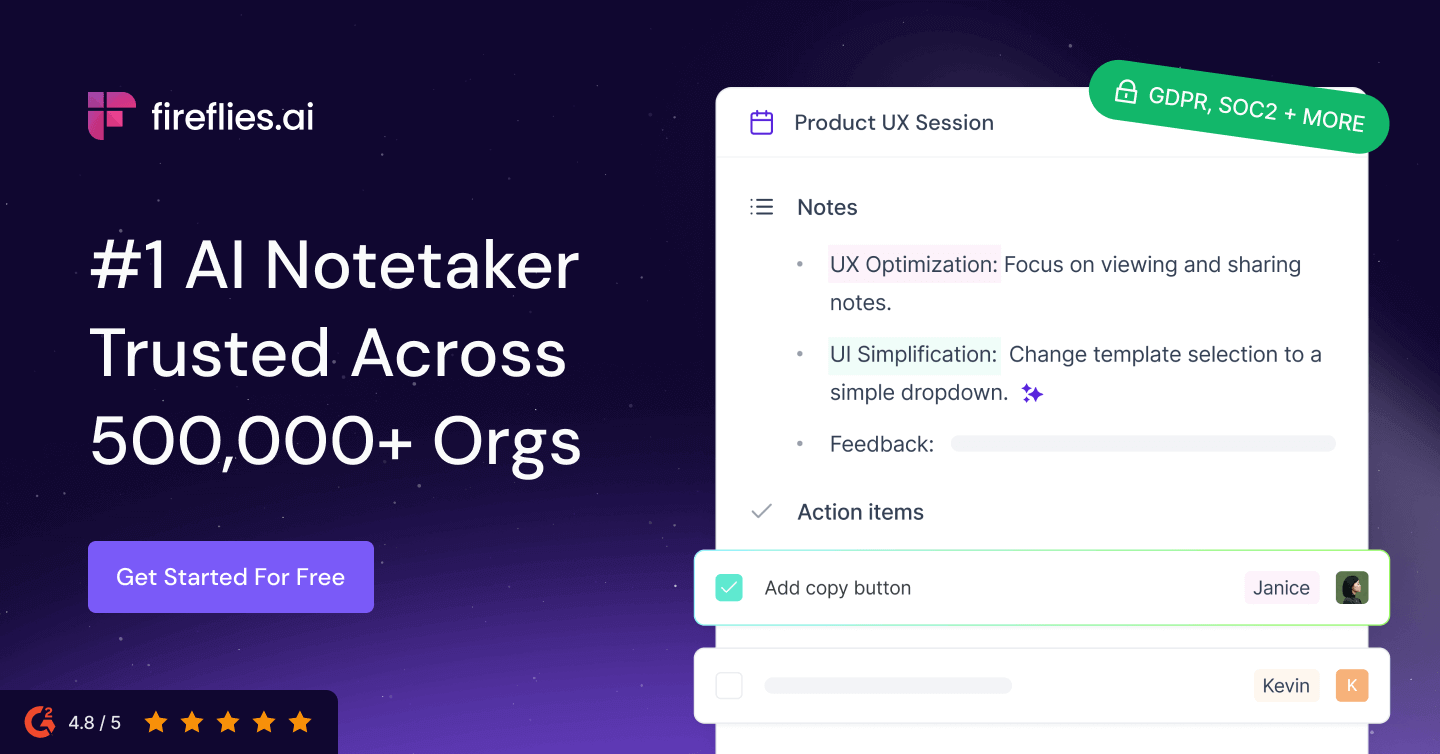
Fireflies is the only dedicated meeting notes app for Chromebooks that captures calls without any manual input. You do not need to download anything. Connect your Google Calendar, and Fireflies joins your calls automatically as a participant. For Google Meet specifically, the Fireflies Chrome extension lets you capture meetings directly from your browser without the bot joining the call at all. You can also add Fireflies to a live meeting mid-call or upload existing recordings.
After every call, Fireflies processes the recording and delivers a full meeting transcript with speaker labels and timestamps, a structured meeting summary with key points, and action items automatically assigned to the people who were mentioned. Each item is timestamped and linked back to the exact moment in the conversation where it came up. You can search across the transcript by topic, sentiment, speaker talk time, questions, and metrics using the Smart Search panel.
Once your notes are ready, AskFred lets you ask questions across all your past meetings in plain language. Instead of scrolling through transcripts, you type a question and get an answer linked back to the exact moment it came up. On Pro and above, you can also set up AI Skills to automatically draft a follow-up email after every call, so the next step happens without you having to think about it.
Fireflies supports transcription in 100+ languages, including multi-language conversations (Business) where participants switch languages mid-call.
Key features:
- Automatic transcription with speaker labels, timestamps, and 100+ language support, including mid-call language switching
- Structured summaries with action items automatically assigned to owners and linked to the relevant moment in the transcript
- Smart Search across topics, sentiment, speaker talk time, questions, and metrics, plus AskFred for natural language queries across all meetings
- AI Skills for automating follow-up emails and next steps after every call, with 200+ built-in skills and custom skill creation
- Claude MCP integration for querying your meeting notes directly from Claude without switching apps
Price:
- Free ($0): Unlimited transcription, limited AI summaries, 800 mins storage per team, transcription in 100+ languages, real-time notes, meeting search, AskFred, Chrome extension
- Pro ($18/seat/month): Unlimited transcription and AI summaries, 8,000 mins storage per seat, video recording, download transcripts and summaries, action items and Task Manager, AI Skills, 20 AI credits/month
- Business ($29/seat/month): Everything in Pro plus unlimited storage, 1080p video recording, Multi-language Mode, conversational insights, 30 AI credits/month
- Enterprise ($39/seat/month, annual only): Everything in Business plus HIPAA compliance, private storage, custom data retention, 50 AI credits/month
Limitations:
- The free plan includes 800 minutes of storage, which fills up quickly for users with regular meeting schedules.
- AI features consume AI credits. Once the monthly allowance runs out, these features pause until the next cycle, or you purchase additional credits.
Also read: How to Write Perfect Meeting Notes: Templates and Tools
Quick View: Chromebook Note-Taking Apps Compared
Every note-taking app on this list works on Chromebook, but they are built for very different workflows (from solo students to remote team meetings). Here is how they stack up across the five criteria that matter most for Chromebook users: free plan, offline access, AI features, and handwriting support.
App | Category | Free Plan | Offline Access | AI Features | Handwriting Support |
Google Keep | Quick capture | Yes | Yes | Limited | Yes (stylus) |
Simplenote | Quick capture | Yes | Yes | Yes (MCP only) | No |
Notion | Structured notes | Yes (limited) | Limited | Yes (paid add-on) | No |
UpNote | Structured notes | Yes (50 notes) | Yes | No | No |
OneNote | Structured notes | Yes | Yes (PWA) | Yes (paid) | Yes |
Squid | Handwriting | Yes | Yes | No | Yes |
Noteshelf | Handwriting | Yes (limited) | Yes | Yes (limited credits) | Yes |
Obsidian | Power users | Yes | Yes | Yes (plugins) | No |
Joplin | Power users | Yes | Yes | No | No |
Fireflies.ai | Meeting notes | Yes | No | Yes (core) | No |
Not sure which is the best note-taking app for your Chromebook? Use this as your shortcut.
- Quick capture: Google Keep
- Structured notes: Notion or UpNote
- Handwriting: Squid
- Linked notes and knowledge graphs: Obsidian
- Meeting notes: Fireflies
Which Note-Taking App Is Right for You?
The best note-taking app for your Chromebook is the one that matches how you actually work. Use this as your shortcut to find yours.
- I want a Chromebook notes app that is already there and free: Google Keep
- I write in plain text and want zero distractions: Simplenote
- I am managing projects, wikis, or team notes: Notion
- I want a clean, affordable alternative to Evernote with offline access: UpNote
- I am already in the Microsoft ecosystem: OneNote
- I take handwritten notes on a touchscreen Chromebook: Squid
- I want handwriting plus PDF annotation and AI assistance: Noteshelf
- I think in linked ideas and want a long-term knowledge base: Obsidian
- I want open-source, privacy-first notes with no monthly fee: Joplin
- I want my meeting notes captured automatically without typing: Fireflies
If note-taking means capturing what happened in a call, Fireflies joins the meeting, transcribes every word, and delivers structured notes with action items before your next call starts. No typing required.
FAQs About Note-Taking Apps for Chromebook
What is the best note-taking app for Chromebooks?
The best app depends on what you need it for. For quick capture, Google Keep is already on your Chromebook and works instantly. For structured notes and research, Notion or UpNote are the strongest options. For meeting notes that capture themselves, Fireflies is the only app on this list that does not require you to type a single word.
Does a Chromebook have a built-in notes app?
Yes, Google Keep comes pre-installed on most Chromebooks and is accessible via browser on any model. If you have a touchscreen Chromebook with stylus support, Google Cursive is also available as a Progressive Web App (PWA), built specifically for handwritten notes and sketches.
Can you use Notion on a Chromebook?
Yes, Notion works on Chromebook via the Chrome browser and as an Android app on Google Play. The browser version covers most functionality, but offline access is limited. Pages you have not recently visited will not load without a connection.
What note-taking apps work offline on Chromebooks?
Google Keep, UpNote, OneNote via PWA, Squid, Noteshelf, Obsidian, and Joplin all support offline access on Chromebooks. Simplenote works offline via the Android app or, if installed as a PWA in Chrome, while online first. Notion has limited offline support on the browser version. OneNote on Chromebook also supports offline access via the PWA installation. Fireflies requires an internet connection to join and process calls.
What is the best free note-taking app for Chromebooks?
Google Keep is the best free note-taking app for Chromebooks for quick capture since it comes pre-installed and requires no setup. For structured notes, Notion's free plan covers unlimited pages for individual users. For handwriting, Squid's free plan covers core note-taking with vector ink and paper templates. For meeting notes, Fireflies' free plan includes unlimited transcription with 800 minutes of storage.
Can I take handwritten notes on a Chromebook?
Yes, but you need a touchscreen Chromebook. The best handwriting note-taking app for Chromebook depends on what you need. Google Cursive works for basic handwriting out of the box on touchscreen models. For a richer experience, Squid and Noteshelf are both available as Android apps on Google Play and support stylus and active pen input. On Chromebooks that support an active pen, the writing experience is significantly more natural and precise.
What is the best AI note-taking app for a Chromebook?
For meeting notes, Fireflies is the strongest AI option on Chromebook. It joins your calls automatically, transcribes in 100+ languages, and delivers structured summaries with action items without any manual input. As an AI notetaker for Chromebooks, Fireflies requires no downloads and works in any browser. For general notes with AI assistance, Notion AI covers writing, summarization, and database autofill on paid plans. Noteshelf includes built-in AI for handwritten notes on its free and premium tiers.