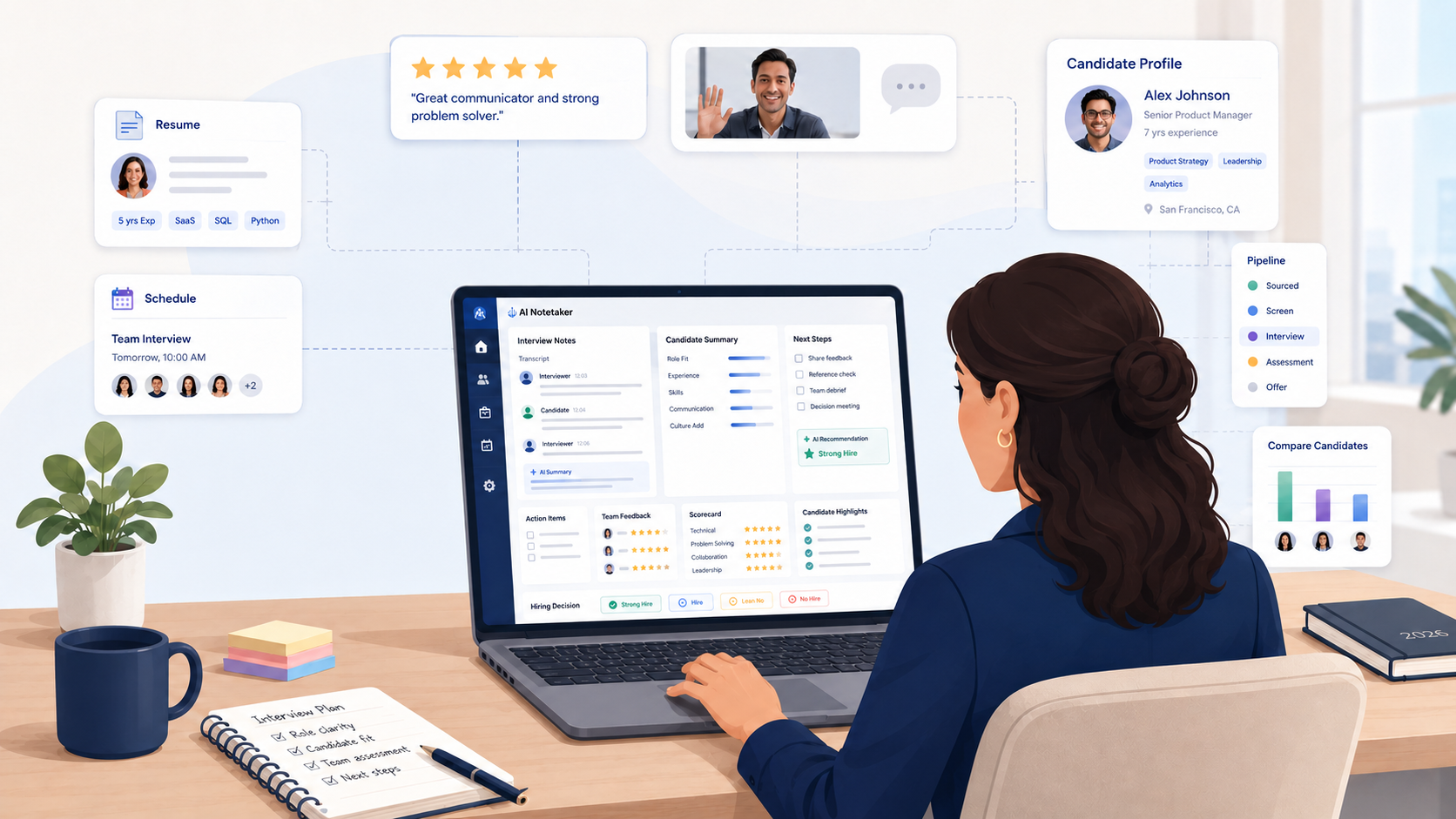

Choosing the best AI notetaker for recruiting can be harder than choosing one for general meetings. Recruiting runs more structured conversations than almost any other function at a company. Phone screens, technical rounds, panels, final calls, and reference checks each have to produce evidence a hiring team can act on, and a record that holds up against consent rules that vary by region. The summary from a tool built for general meetings can read like any other recap, when an interview needs an evaluation a recruiter can use. The best AI notetakers for recruiting in 2026 also automate the handoff into your applicant tracking system, so the record reaches the hiring team without anyone retyping it.
If you are a recruiter weighing the options, this article breaks down the criteria that matter, compares the 6 tools worth considering in 2026, and helps you choose the right fit.
What Recruiting Teams Need From an AI Notetaker
When evaluating what recruiters should look for in an AI notetaker, prioritize tools built for hiring workflows rather than generic meetings. The essential criteria include stage-specific structured outputs, automatic ATS integration, unobtrusive recording options, strict data privacy, and the ability to scale across high interview volumes.
Structured outputs for each interview stage
A recruiter screen, a technical round, and a final panel each capture different things, so the output a notetaker produces has to match the stage rather than flatten every call into the same recap. A capable AI notetaker should turn the conversation into a structured evaluation tied to the criteria you hire against, built from what was actually said.
Fireflies fits the recruiting case here through AI Skills, customizable templates that generate evidence based candidate evaluations mapped to your rubric for the stage you are running. A screening call can return notice period and motivation, a technical round a competency breakdown and a recommendation, each pulled from the transcript.
ATS integration that syncs automatically
An AI notetaker earns its place in recruiting when the evaluation reaches your applicant tracking system without anyone copying it across. The summary, the recap, and the candidate scorecard should post to the candidate record on their own, so the gap between the end of an interview and a hiring manager reading the notes closes itself.
Fireflies syncs natively across popular applicant tracking systems, such as Greenhouse, Lever, and BambooHR. You connect each one once, and from then on every summary and scorecard files itself to the right candidate record.
Candidate experience and how the tool joins the call
How a notetaker joins an interview is part of the candidate's experience, and it weighs more as the role gets more senior. A bot visible in the call works for most hiring, but for executive search or confidential roles it can feel intrusive to a candidate who is still employed elsewhere, so the tool should let you choose how you capture while keeping the candidate informed either way.
Fireflies gives you more than one way in. The AI Notetaker joins as a participant for standard interviews, and the Chrome Extension captures from your browser without adding a bot to the call when a lighter footprint suits the role. Consent stays explicit in both, disclosed in the calendar invite or stated at the start of the call.
Compliance, consent, and data privacy in hiring
Recording a candidate carries legal weight that varies by state and country, which makes consent and data handling a real selection criterion rather than a footnote. A recruiting tool should confirm candidates were informed before recording, let you control how long transcripts are kept, and meet GDPR obligations for EU applicants. Its policy on training AI with your data should be explicit too.
For teams that need enterprise security, Fireflies is SOC 2 Type II and GDPR compliant on every plan including Free, with HIPAA and FERPA on Enterprise. On AI training, Fireflies states it plainly. Fireflies.ai does not use customer data to train any AI models. Your personal data is never used to train AI models. Users own their data.
Handling interview volume
Hiring volume multiplies interviews and the admin attached to each one. A single open role can run dozens of screens, and the value of an AI notetaker at that scale is that capture and recall happen on their own instead of becoming manual hours.
Fireflies joins scheduled interviews from your calendar automatically, so no call depends on someone remembering to hit record. When you need something back, AskFred answers questions across every past candidate conversation at once, so finding who raised compensation or which candidate mentioned a specific tool takes a question instead of scrolling through weeks of recordings.
6 Best AI Notetakers for Recruiting: Compared
The 6 tools below are the ones worth evaluating for hiring work in 2026, scored on the criteria above rather than on generic transcription accuracy.
| Tool | Best for | Native recruiting ATS | Stage scorecards | Conducts the screening call | Free plan | Starting paid price |
|---|---|---|---|---|---|---|
| Fireflies | Best overall for recruiting teams | Greenhouse, Lever, BambooHR | Yes, via AI Skills, pushed to the candidate record | Yes, via Voice Agents | Yes | $10/seat/mo, billed annually |
| Metaview | Configurable recruiting notes | Greenhouse (scorecard autofill), Lever, Pinpoint | Yes, autofills Greenhouse scorecards | Resume/application screening only | Yes, notetaker 25 calls/mo | $60 a seat (notetaker) |
| BrightHire | Enterprise interview intelligence | Greenhouse, Lever, Ashby, Workday | Yes, one-click into ATS fields | Yes, BrightHire Screen | No | Enterprise, no public pricing |
| Fathom | Solo recruiters, low volume | None native (Zapier or manual) | No (sales-coaching scorecards only) | No | Yes, most generous | ~$15 a seat (annual) |
| Fellow | Secure meeting productivity | None native (Zapier or manual) | No | No | Yes, 5 notes and 5 recordings | $7 a seat (annual) |
| Carv | High volume hiring | Yes, syncs structured data to ATS | Structured write-ups, not a rubric scorecard | Yes, screening agents | No, 5 to 10 interview trial | Demo only, no public pricing |
Fireflies joins your interviews, structures your notes by stage, and logs everything to your ATS automatically. Free plan available.
1. Fireflies: Best overall for recruiting teams
Fireflies usually gets filed under AI notetakers, but that label undersells what it does. It is the #1 AI Assistant for meetings, email, Slack, CRM, and work. It joins your interviews and comes with transcriptions, summaries, and recordings of them. It also supports transcription in over 100 languages, making it incredibly useful for global teams that operate in languages other than English.
The breadth goes past the call itself. Its AI Skills which enable post-meeting automations across 100+ tools, including standard recruiting tools. Additionally, AskFred, the built-in AI assistant, can answer questions across your meetings, Slack, email, and CRM. That breadth is why it covers the recruiting workflow other tools leave half done.
With its integration to popular ATS platforms, recruiters can ensure that the finished interview lands in the candidate record on its own. They can utilize its AI Skills to generate evidence based candidate scorecards mapped to your rubric, and request AskFred to pull what a candidate said about salary or a past project straight from the transcript.
How you capture is up to your team and your policy. You can connect Fireflies to your calendar so it joins automatically, add it by hand once a meeting is underway, record from the Desktop App, or use the Chrome Extension instead of a bot.
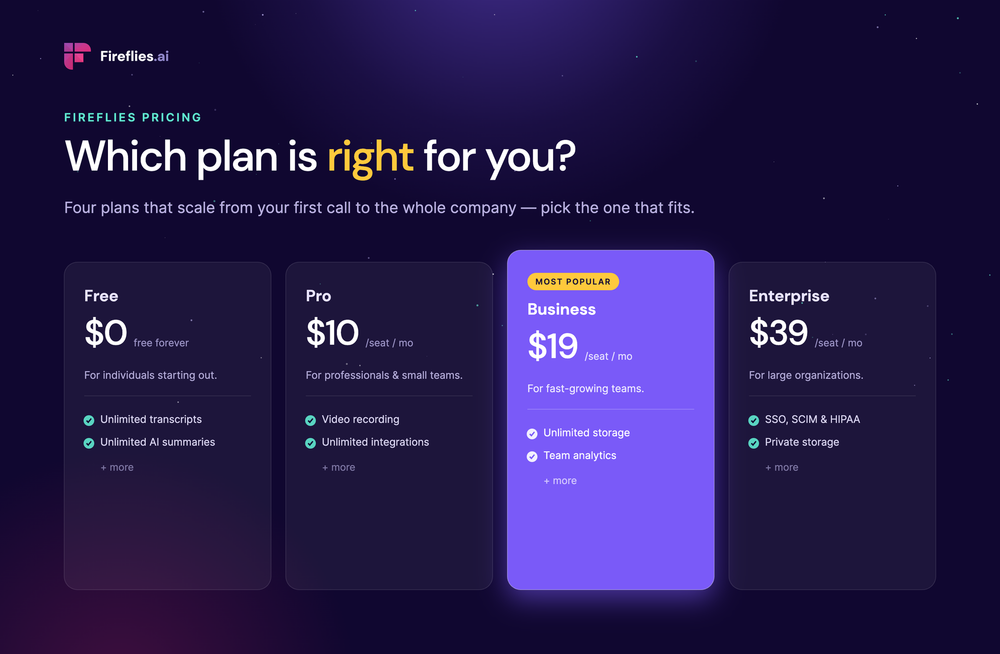
Fireflies is free to start, and the free plan covers unlimited transcription and AI summaries, AskFred, the Chrome Extension, with 400 minutes of storage per team. The recruiting features sit on the paid plans, so if you want AI Skills scorecards, native ATS sync, and Voice Agents, Pro starts at $10 a seat a month. The pricing is well under Metaview and BrightHire.
On the compliance side, Fireflies is SOC 2 Type II and GDPR compliant on every plan, including Free, with HIPAA & FERPA compliance on Enterprise.
Fireflies reports that HR teams on the platform save about 8 hours of admin a week and hire 40% faster. Here is what the output looks like for a recruiting use case:
Recruitment Agent <> Will Interview
Candidate Background
- 4 years of experience in backend development, currently with BrightStack Technologies.
- Previously built internal tools for API monitoring and log tracking.
Technical Overview
- Proficient in Node.js, Python, and PostgreSQL.
- Good understanding of microservices and API performance tuning.
Candidate scorecard
| Criteria | Notes | Rating |
|---|---|---|
| Technical Depth | Solid core concepts | 4/5 |
| Problem-Solving | Structured reasoning | 4/5 |
| Code Quality | Clean, maintainable code | 3/5 |
It also runs autonomous first round screening through Voice Agents. If that is the part you came for, we unpack it in full right after the roundup.
2. Metaview: Best for configurable recruiting notes
Metaview is an agentic recruiting platform with separate agents for sourcing, application review, and notetaking. The notetaker joins recruiting calls over video or phone and turns intakes, screens, interviews, and debriefs into structured notes the moment a call ends. The strength is how much you can shape the output. You can choose bullets or paragraphs, set how much detail a hiring manager sees, organize by question or by topic, and build templates for your own interview structures. Metaview autofills Greenhouse scorecards and links notes to candidate records in Lever and Pinpoint based on the notes grounded in the role and the candidate. On security, Metaview holds SOC 2 Type II and complies with GDPR and CCPA.
Metaview's agents are priced separately, and sourcing, application review, and notetaking each carry their own cost. Every account grants access to the full platform, but you only activate and pay for the agents you use. For a plan that includes all of them, you contact their sales team for a custom Enterprise quote.
The free tier for its notetaker agent covers 25 calls a month with basic transcription. Paid plans offer unlimited calls and priority processing, starting at $60 per seat per month.
3. BrightHire: Best for enterprise interview intelligence
BrightHire is an interview intelligence platform that Zoom acquired in late 2025. It is built for the interview layer of hiring, from planning interviews to running them and turning them into decisions.
Its notetaker, AI Interview Notes, structures the notes around the competencies your team set beforehand. It then maps those details to your ATS scorecard fields and drafts the scorecard so a recruiter can submit it in a single click. To support global hiring, the platform also operates in more than 30 languages.
When it comes to ATS integration, BrightHire features deep, native connections to Greenhouse, Lever, Ashby, and Workday for scorecard completion. During the live interview, BrightHire’s assistant works natively inside Zoom. For Google Meet and Microsoft Teams, it can be added through supported meeting/calendar workflows.
BrightHire also runs the screening call itself via BrightHire Screen. This asynchronous AI interviewer conducts first round screens over voice or video, asks your structured questions, and scores answers against your rubric, then returns ranked summaries to the ATS.
Like Metaview, BrightHire works only inside recruiting. Its Interview Intelligence platform comes in three tiers: Recruiters, Teams, and Enterprises, with no public pricing and no free plan. You can purchase BrightHire Screen on its own or added to any of them. On security it is SOC 2 Type II certified and GDPR and CCPA compliant, with role based access controls, custom retention, consent first recording, and annual bias audits.
4. Fathom: Best for solo recruiters and low volume hiring
Fathom is a free AI notetaker that records, transcribes, and summarizes meetings across Zoom, Google Meet, and Teams. It covers any kind of call through a library of summary templates, and it is built for fast, accurate output.
For recruiting, the useful piece is its Candidate Interview template, which shapes the summary around a candidate's experience, goals, and answers, so an interview comes back as a structured write up. The summaries are quick and accurate, you can pull the key moments without replaying the call, and Ask Fathom lets you search across past interviews for what a candidate said. Its speaking pattern tracking can also flag when an interviewer talked more than the candidate, a useful check on interview discipline.
The gaps show up around the hiring stack. Fathom's integrations point at sales platforms like Salesforce and HubSpot, with no native applicant tracking system connection, so moving interview notes into Greenhouse or Lever takes a Zapier workflow or manual copying. The Candidate Interview template shapes the notes well, but it lives inside Fathom's summaries and never writes to a scorecard or a candidate record. Its AI scorecards are a separate feature built for sales call coaching. They grade how a call was run and are not set up to evaluate a candidate against a hiring rubric.
On pricing, the free plan is the most generous in this comparison, with unlimited recordings and transcription, though the advanced summaries are capped. Paid plans start around $15 a seat a month billed annually, or $19 monthly, with a two seat minimum, and the bot free capture option is still a Mac beta, so most video interviews still get a visible bot. On security, Fathom is SOC 2 compliant.
5. Fellow: Best for agenda-driven teams
Fellow comes at meetings from the productivity side. It started as a tool for shared agendas, decisions, and accountability, then added an AI notetaker that records, transcribes, and summarizes calls on Zoom, Google Meet, and Teams.
For recruiting, the feature that matters is a Candidate Interview template, one of its 17 AI note templates, which structures an interview summary around a candidate's background, goals, and concerns. You can add custom sections to capture things like role competencies or compensation expectations, and recap emails with surfaced action items keep follow ups from slipping. The agenda and collaboration layer also suits the team side of hiring, giving intake meetings, debriefs, and hiring syncs a shared structure.
The depth specific to hiring is not there. Fellow has no native ATS integration, only CRM and project management sync to tools like HubSpot, Slack, and Asana, so interview notes reach Greenhouse or Lever by hand or through a workaround. The Candidate Interview template shapes the summary, but it stays inside Fellow's notes and does not populate a scorecard or a candidate record. There is no recruiting scorecard, candidate scoring, or screening of any kind.
On pricing, the free plan is capped at 5 AI notes and 5 recordings for the life of the account, so it works as a trial more than a daily tool. Paid plans start at $7 a seat a month billed annually, with Business at $15 and Enterprise at $25. Security is the angle Fellow markets hardest, branding itself as the most secure meeting assistant in the category.
6. Carv: Best for high volume hiring
Carv is a recruiting agentic platform aimed at high volume hiring, running recruitment agents across the funnel, from candidate engagement and screening to scheduling and the write up after a call. Its customers skew toward staffing firms and large employers.
Its AI Note Taking module records, transcribes, and takes notes during interviews and intakes so the recruiter can stay in the conversation. Carv joins candidate calls over video, phone, or in person, and the notes come back structured for hiring, with sections like background and experience, strengths, motivation, and next steps.
After the call, Carv turns the conversation into structured data and syncs it to your ATS, mapping fields like personal information, interview notes, summary, and next steps onto the candidate record. From the same interview it can generate a candidate profile and a full write up in your own voice and format, and an AI editor lets you clean those up before they go out.
Carv is sold through a demo, with a short trial of five to ten interviews to test it before moving to a Recruitment Pro or Enterprise plan priced for your team. It does not list public prices, which is normal for the recruiting platforms in this comparison, and it works only inside recruiting, so it does nothing for your other meetings.
On compliance, Carv holds SOC 2 Type II and three ISO certifications, 27001 for information security, 27701 for privacy, and 42001 for AI management. It also complies with GDPR and CCPA while aligning to the EU AI Act's high risk requirements. Data is encrypted with AES-256, hosted in the EU on Google Cloud, and gated by role based access with SSO.
How Fireflies Voice Agents Handle First Round Screening
Fireflies Voice Agents run the screening interview themselves, with no recruiter on the call. The agent holds a real conversation, asking your structured questions, listening, and adapting its follow ups to what the candidate actually said. It runs in more than 32 languages for global pipelines. That fits the first round, which usually runs the same fixed questions for every applicant.
Setting up a Voice Agent takes under five minutes for most roles. You select the role, Fireflies drafts the screening questions from that choice, and you edit, cut, or add to them. You can also set the tone, the length, and the language, and attach a knowledge base of role details or company information for the agent to draw on when candidates ask questions. Once it is ready, you share the agent however suits the role, as a link, an embed, a QR code, or straight from your ATS. Candidates join from any device with no app and no download, on their own schedule, day or night, with no calendar coordination on either side.
When the call ends, you get a transcript, a summary, and action items, and an AI Skill produces a candidate scorecard you can use to rank and compare everyone who screened for the role. AskFred answers questions across all of those screens at once, so you can ask what a candidate said about salary or notice period and read it straight from the transcript instead of listening through the whole call. The scorecard, summary, transcript, and recommendation push into the candidate record through native connections to Greenhouse, Lever, BambooHR, and more.
Screening with Fireflies Voice Agents is free to start, no card required. Voice Agents use dynamic AI credit pricing, so credit usage depends on the complexity and length of each screening call.
How to Choose Based on Your Recruiting Setup
The best AI notetaker for recruiting depends on how your team hires. Below are 3 situations that cover most recruiters.
- If you want ATS sync, candidate scorecards, volume screening, and enterprise compliance in one platform, Fireflies is the fit. It puts the full recruiting toolkit, interview notes, AI Skills scorecards, and autonomous screening, in one place for far less than the recruiting specialists charge. Seats start free with paid plans from $10 a month on annual billing, and Voice Agents screening has its own free plan, so you can explore both before you commit.
- If you run a highly structured interview process at scale and need the deepest ATS scorecard automation, Metaview or BrightHire earn the premium. Both are built only for recruiting and write structured feedback straight into the ATS, which goes deeper on native scorecards.
- If you are an individual recruiter or small team just getting started and want a free tool with clean summaries and no setup, Fathom is the easiest entry point. Its summaries are clean and there is nothing to configure, though you will move notes into your ATS by hand and you will not get recruiting scorecards.
Frequently Asked Questions
What is the best AI notetaker for recruiting?
For most recruiting teams, Fireflies is the best overall choice. It brings native ATS integration, stage specific candidate scorecards through AI Skills, and automated first round screening with Voice Agents into one platform. Fireflies also offers free plans to begin with and its paid plan starts at $10 per seat (monthly). Metaview and BrightHire go deeper on ATS scorecard write-back but only work inside recruiting, while Fathom and Fellow handle basic recording without native ATS sync or recruiting scorecards.
Do AI notetakers integrate with Greenhouse and Lever?
Some do. Fireflies connects natively to Greenhouse, Lever, and BambooHR. Recruiting-focused tools like Metaview and BrightHire integrate even deeper with Greenhouse and Workday with scorecard autofill. Most general notetakers, including Fathom and Fellow, reach these systems only through Zapier or manual copying instead of a direct integration.
Is it legal to record job interviews with AI?
In most cases yes, with consent. United States recording laws vary by state, and all party consent states including California, Florida, Illinois, Pennsylvania, and Massachusetts require every participant to agree before recording. EU candidates are covered by GDPR, which treats interview recordings as personal data that needs a lawful basis to process. The safe practice everywhere is to tell candidates before the interview that AI will record and take notes, and to document that they agreed. This is general information rather than legal advice.
Can AI notetakers auto-fill ATS scorecards?
Yes, but not all of them. Metaview and BrightHire write scorecard fields straight into the ATS, while Fireflies generates the scorecard through AI Skills and pushes it into the candidate record. General notetakers like Fathom and Fellow return meeting summaries with recruiting template, so still requiring the recruiter to build the scorecards manually.
What is the difference between Fireflies and Metaview for recruiting?
Metaview offers deeper integration to Greenhouse with scorecard autofill, while Fireflies integrates with Greenhouse through AI Skills. You connect Greenhouse, then set an AI Skill to run after each interview that builds the scorecard from the transcript and pushes it into the candidate record. Although both tools offer free plans, Metaview prices its notetaker from $60 a seat and its screening from $100 a seat, while Fireflies starts at $10 a seat for its notetaker and offers Voice Agents with dynamic AI credit pricing.
What is the best free AI tool for interview notes?
Fireflies is the strongest free pick for recruiting, with unlimited transcription and AI summaries, AskFred, and a bot free Chrome Extension that records without a visible bot. Fathom has the most generous free plan for raw recording volume, with unlimited recordings and transcription, though it offers no ATS sync or scorecards. Fellow's free tier is the most limited, capped at five notes and five recordings.
Can AI conduct the interview for me?
Yes, for first round screening. Fireflies Voice Agents run structured screening interviews on their own, asking your questions, talking with candidates over a shared link at any hour, and returning a transcript, summary, and scorecard. Final and panel rounds still belong with a recruiter.
Conclusion
Recruiting teams run structured conversations that have to land accurately in an ATS, produce evaluations a hiring team can act on, and meet consent and privacy rules that shift by region. Most AI notetakers were built for general meetings and leave recruiters to do the recruiting parts by hand. With Fireflies, recruiters can run automated first round screening with Voice Agents, generate stage specific interview notes and scorecards through AI Skills, and log everything to Greenhouse, Lever, or BambooHR automatically.
Fireflies joins your interviews, structures your notes by stage, and logs everything to your ATS automatically. Free plan available.