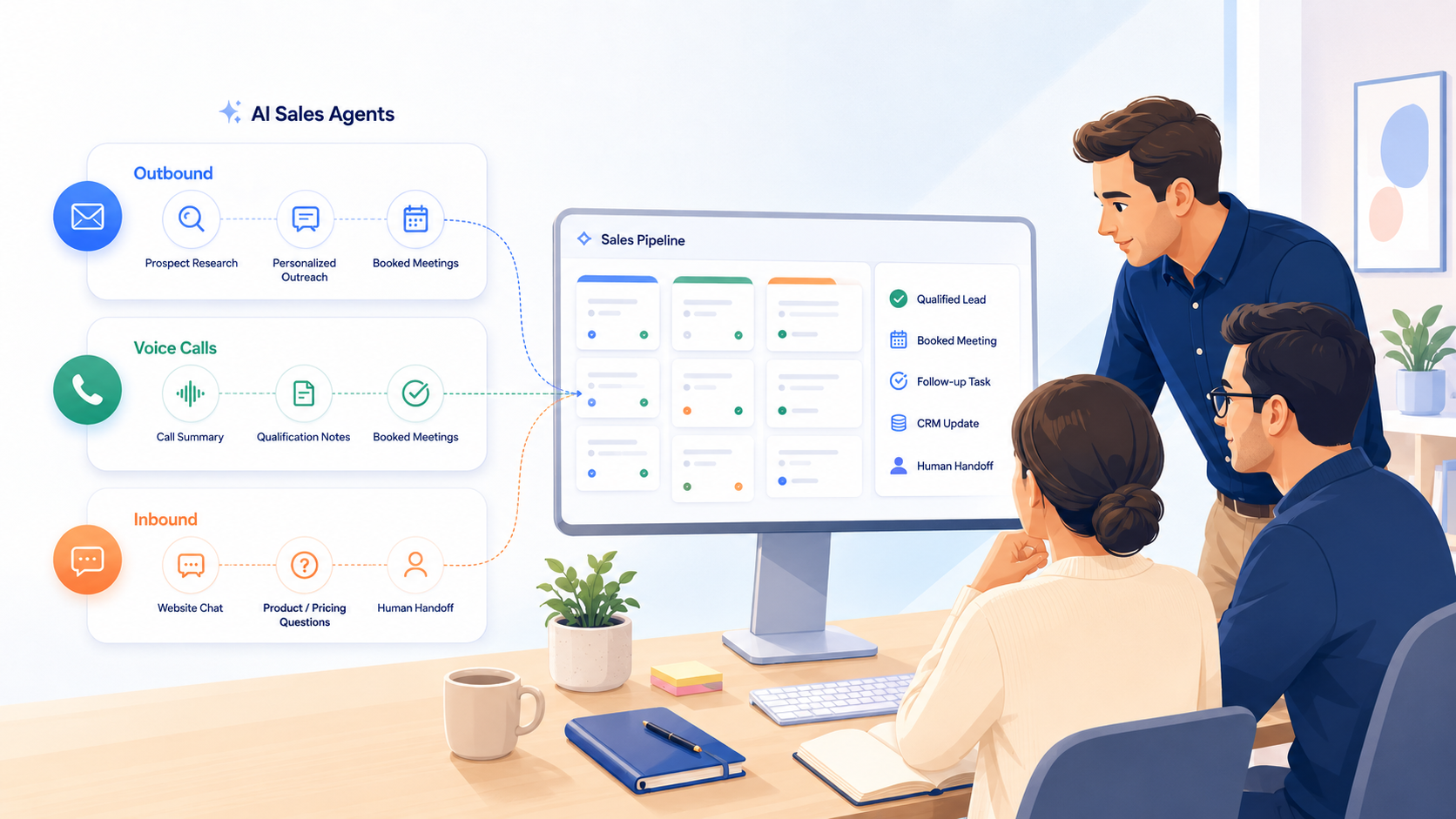

An AI sales agent handles a defined sales motion on its own, such as outbound prospecting, lead qualification, or follow up, without a rep driving every step. Sales teams spent the last decade automating the busywork around selling, from logging calls to scheduling emails, and the newer shift is automating the selling conversation itself.
The label now covers several products that do genuinely different jobs, which is where most buyers get stuck. An outbound email agent and a voice qualification agent share almost nothing in how they work or what they suit, so the decision that matters is which type fits the motion you want to automate and whether that motion is one these agents handle well yet.
This guide sorts the category by the motion each agent runs, so you can see what AI sales agents are, how each type works, and how to choose the one that fits your team.
What Is an AI Sales Agent?
An AI sales agent is autonomous software that runs a sales motion without a person managing each step. Day to day, the work breaks into a few core tasks.
- Researching accounts and building target lists.
- Writing and sending personalized outreach.
- Qualifying leads against criteria you set.
- Running live qualification or discovery calls.
- Booking meetings and handing off to a rep.
- Logging outcomes and updating the CRM.
Unlike older sales automation, an AI sales agent decides what to do next inside the guardrails you set. Traditional sales automation follows fixed rules, like sending sequence step two when step one gets no reply. An AI sales agent works from a goal. You give it a target, a knowledge base, and limits on what it can say, and it chooses the wording, the timing, and the next move on its own. Most run a single repeatable motion from start to finish while a person sets the strategy and steps in on anything unusual.
Two things converged in 2026 to make this practical. The models got good enough to handle the open ended moments, like a lukewarm reply or an off script question on a live call. At the same time, the surrounding tooling matured enough for an agent to pull a list, send from a real mailbox, place a call, and update the CRM on its own.
The Three Categories of AI Sales Agents in 2026
In 2026, AI sales agents come in three types, each defined by the motion it runs. Outbound text and email SDR agents prospect in writing, voice and meeting agents run spoken calls, and inbound conversational agents qualify the interest that lands on your site.
These three don't compete. They cover different stretches of the same funnel, so a modern sales org often runs all three at once.
| Category | What it does | Example tools | Best use case |
|---|---|---|---|
| Outbound text and email SDR agents | Research prospects, run personalized outreach at volume, qualify replies, and book meetings | 11x, Artisan, AiSDR | Top of funnel pipeline generation |
| Voice and meeting agents | Hold spoken qualification and discovery calls, capture the conversation, route the outcome to the CRM | Fireflies Voice Agents | Permission based voice qualification |
| Inbound conversational agents | Answer and qualify visitors who arrive on a site or in a product, then route or hand off | Salesforce Agentforce, Intercom Fin, HubSpot | Inbound qualification and FAQ deflection |
1. Outbound Text and Email SDR Agents
These agents run outbound prospecting end to end. They pull a target list, research each account, write and send a personalized sequence, read the replies, and book the meeting when a prospect bites. The work that used to fill an SDR's morning is the work they automate at volume.
They work best for top of funnel pipeline generation, where a small team can cover the prospecting of a much larger one. They earn their keep on cold, repeatable outreach and struggle once a deal needs judgment or a real relationship. The names buyers meet first are 11x, Artisan, and AiSDR.
2. Voice and Meeting Agents
Voice agents hold the conversation out loud. They run a spoken call, ask questions, follow up on the answers, and capture what was said. One split inside this type decides whether the agent helps or hurts.
Cold outbound voice dials prospects who never asked for the call, which carries regulatory exposure and tends to produce stilted calls, so it stays risky in 2026. Permission based voice is the other half, where a lead clicks a link or fills a form, verifies identity, and talks to an agent answering interest they raised themselves.
They work best for qualification and discovery calls where conversation quality matters more than raw volume. Fireflies Voice Agents is the option built for this motion, covered in detail below.
3. Inbound Conversational Agents
Inbound conversational agents handle interest that comes to you. They live on a website, a pricing page, or inside a product, answer questions in chat, qualify the visitor, and book a meeting or hand off when the lead is worth a rep.
They work best for inbound qualification and FAQ deflection at scale, catching every visitor with a question without staffing a chat queue around the clock. The catch is that they only work traffic that already arrived, so they create no pipeline on their own. The common choices are Salesforce Agentforce, Intercom Fin, and HubSpot.
What to Look For in an AI Sales Agent
There's no single best AI sales agent, because the right choice depends on the motion you're automating and how much you can safely hand off. The practical move is to evaluate any agent against a short set of operational checks below:
- Motion fit. The strongest agents own one job, like outbound email or inbound qualification, and do it well. Treat any claim to run the entire funnel as a reason to dig deeper.
- Knowledge grounding. Check whether the agent answers only from the materials you give it or fills gaps on its own. The reliable ones stay inside your pricing, your product facts, and your objection handling, and they admit when they have no answer.
- CRM write back. A useful agent pushes structured fields into your CRM, like budget, authority, and next step. Ask to see which fields it writes and where they land before you trust the summary.
- Guardrails and control. You should be able to set what the agent can say, what it must avoid, and when it stops. Without that, one bad answer goes out at scale before anyone notices.
- Human handoff. The agents worth buying hand the lead to a rep the moment they hit their limit, with the full context attached. Every agent reaches that point, so the handoff is what keeps the conversation alive.
- Stack fit. The agent should connect to the CRM, dialer, and tools you already run. One that assumes you live inside a single vendor's stack will lock you in and leave gaps everywhere that stack does not reach.
- Compliance and data handling. For anything touching customer conversations, confirm the basics, including SOC 2 Type II and GDPR, and check that your data is not used to train shared AI models. Regulated teams should verify HIPAA or FERPA coverage before a pilot.
- Pricing model fit. Match the pricing model to your volume, because agents billed per call or per minute scale very differently from a flat per seat license once real traffic arrives.
The Leading AI Sales Agents in 2026
The tools below are grouped by category, because the name only matters once you know which motion an agent runs.
Outbound SDR Agents
- 11x builds what it calls digital workers for sales. Its outbound agent, Alice, runs prospecting from end to end, researching accounts, writing personalized multi channel sequences across email and social, nurturing and reactivating leads on signal based triggers, and booking meetings around the clock, in 105+ languages. 11x runs the email infrastructure too, with managed mailboxes, warmup, and deliverability monitoring built in. Alice starts at $3,750 a month billed annually on the entry tier, with higher tiers priced through sales, so the floor sits above what a small team testing the category usually spends. A separate agent, Julian, covers voice and website chat for inbound qualification.Best for outbound programs that want an autonomous SDR owning prospecting across channels.
- Artisan sells Ava, an AI BDR that runs the full outbound motion. Ava finds leads from a large B2B database, enriches them, writes personalized email sequences, runs autonomous A/B tests, handles replies and objections, and books meetings, with a built in dialer for the phone steps. Teams set the strategy and the guardrails, then let Ava run campaigns autonomously. Pricing is self serve and credit based, with a free plan at 300 credits a month for exploring, a paid Intern tier from $250 a month billed annually, and an Employee tier at $600 that adds advanced campaigns and a Salesforce sync.Best for high volume outbound email programs that want to consolidate a prospecting stack into one tool.
- AiSDR is an AI SDR aimed at smaller and mid market teams. It finds prospects, researches them, writes personalized email and LinkedIn messages, runs AI call steps inside sequences, answers replies and common objections, qualifies interest, and books meetings once a prospect is ready. Pricing starts at $250 a month on the entry Solo tier for a single user, with larger tiers at $900 and $2,500 a month, and there is no free trial. Solo is cancel anytime, while the higher tiers run on a quarterly commitment.Best for founder led and mid market outbound teams that want one system for prospecting and first touch qualification.
Voice and Meeting Agents
Fireflies Voice Agents run qualification and discovery calls that a lead opts into, usually by clicking a shared link, verifying identity, then talking to the agent. The agent works from a knowledge base you supply, captures the conversation, and routes the outcome into your CRM. It sits inside the wider Fireflies sales stack, covered in the dedicated section below.Best for voice motions where conversation quality outweighs raw call volume, in orgs that want one platform across automated and rep led calls.
Inbound Conversational Agents
- Salesforce Agentforce includes a sales development agent that engages leads around the clock, answers questions, handles objections, qualifies against your criteria, books meetings, and hands off to a rep with a summary. It runs on Salesforce data through the Atlas reasoning engine and is configured in a low code builder. Salesforce prices Agentforce by consumption, publishing rates of $500 per 100,000 Flex Credits or $2 per conversation, with credits drawn down as agents take actions, so total cost tracks usage.
Best for orgs already standardized on Salesforce. - Intercom Fin started in support and now runs a sales role inside the same agent. Fin handles inbound conversations end to end, qualifying prospects conversationally on use case, budget, and timing, booking meetings, and syncing to the CRM. Fin bills per outcome, starting at $0.99, with sales qualifications charged at $9.99. It runs two ways. Added to an Intercom plan, it sits on a per seat subscription that starts at $29 a month on Essential billed annually and rises through Advanced at $85 and Expert at $132. Bolted onto an existing helpdesk, including Salesforce, it runs standalone with no seats and bills only on outcomes.
Best for product led companies that want inbound qualification and support in one agent, and for Salesforce teams adding an agent without replacing their helpdesk. - HubSpot runs its agents under the Breeze brand, grounded in HubSpot CRM data. The Customer Agent answers inbound questions using content you already have and escalates to a rep with context, while a separate prospecting agent handles outbound research and outreach. Both moved to outcome pricing in April 2026, paid in HubSpot Credits, at 50 credits per resolved conversation for the Customer Agent and 100 credits per recommended lead for the prospecting agent, which HubSpot equates to $0.50 and $1. Both run on Professional and Enterprise plans and come with a 28 day trial.
Best for teams already running HubSpot that want CRM native agents without adding a vendor.
How Fireflies Voice Agents Works
Fireflies Voice Agents run live sales calls on their own, with AI conducting a natural, two-way conversation that adapts to each answer in real time. You pick a template or build an agent from scratch, give it the questions to ask, load a knowledge base from uploaded files or a URL, and set guardrails for what it can and cannot say. On the call, it works from exactly that, answering a pricing or product question accurately and declining anything outside the knowledge you gave it. Once the agent is live, you share its link. A lead opens it, confirms their identity with a one time code when you require email verification, and starts talking. The agent runs on its own 24/7 in 30+ languages, with no scheduling and no rep on the line.
Teams already on Fireflies add Voice Agents without onboarding a new vendor, and the agent plugs into the rest of the product suite. AI Notetaker captures the calls reps run themselves, Deal Intelligence surfaces deal context across both kinds of call, and AskFred lets a sales leader search the full archive in plain language, asking what objections came up this month or which deals mentioned a competitor. The same record feeds the wider sales tooling, where CRM Skills autofill the CRM from call data, AI Skills run the post call workflows, and Live Assist coaches reps in real time on the calls they handle themselves. A point solution gives you the voice call and stops there, while every Voice Agents call lands in the same record as every human one.
Fireflies Voice Agents fit two sales motions especially well, fast inbound qualification and structured discovery. When a lead comes in, the agent starts the conversation within seconds, where a callback would take hours, qualifies against your criteria, captures the outcome, and hands a clean meeting summary to the rep. On discovery, it runs a first pass that surfaces pain points, priorities, and timeline, so the AE walks in already briefed.
Voice Agents earns its place on repeatable motions with clear guardrails, the calls that follow a known shape. Pointed at that work, it runs every call the same way and frees the team for the conversations that need a person. It is not a substitute for high touch enterprise discovery or complex negotiation.
Use Cases: Where AI Sales Agents Work and Where They Don't
In 2026, AI sales agents handle defined, repeatable motions well and struggle with the ones that turn on judgment. Here is where they earn their keep and where a person still carries the work.
Where agents perform well:
- Outbound prospecting at high volume. Agents research accounts, personalize emails, and run sequences at a throughput no human team matches.
- Inbound lead qualification. Agents answer common questions, qualify against set criteria, and schedule or route in the moment.
- Follow up calls and scheduling. Autonomous voice calls set next steps with warm leads who already expect the contact.
- Pipeline hygiene. Agents check stalled deals to confirm status and keep CRM records current without manual cleanup.
Where humans still carry it:
- High touch enterprise discovery. Deals across several stakeholders turn on nuanced product fit and judgment an agent does not have.
- Negotiation and pricing conversations. These hinge on relationship and read of the room, which an agent cannot replicate.
- Cold outbound voice at scale. Consent rules under the TCPA and uneven call quality make it risky, so it stays a poor fit in 2026.
- Deep product knowledge across complex catalogs. Wide SKU and feature sets expose the limits of what an agent can hold accurately.
Frequently Asked Questions
What's the difference between an AI SDR and an AI sales agent?
An AI SDR is one type of AI sales agent, focused on the SDR job of outbound prospecting and inbound qualification. AI sales agent is the broader term, covering outbound SDR agents, voice agents that run calls, and inbound conversational agents. Every AI SDR is an AI sales agent. Not every AI sales agent is an AI SDR.
Can AI replace SDRs?
AI cannot replace SDRs entirely, at least in 2026. It replaces the repetitive part of the role, the research, list building, first touch outreach, and follow up, while the judgment work stays human, complex qualification, objection handling on a live call, and relationship building. Most teams that succeed with these tools run the agent for volume and keep people for the conversations that close.
Can AI run sales calls autonomously?
Yes, AI can run sales calls autonomously, within limits. Voice agents handle inbound qualification and discovery calls from start to finish, asking questions, answering from a knowledge base, and routing the outcome to the CRM, with no rep on the line. They hold up best when the lead opts into the call and the conversation follows a known shape.
How much does an AI sales agent cost?
AI sales agent cost splits by pricing model. Outbound SDR agents range from about $250 a month for self serve tools to enterprise contracts in the tens of thousands a year. Voice and inbound agents increasingly price per outcome, for example a set charge per resolved conversation or per qualified lead. Credit based pricing, where you pay per action or per minute of call, is now common across the category, so cost scales with how much the agent does.
Are AI sales agents legal to use for outbound calls?
AI sales agents are legal for outbound calls only with the right consent. The FCC ruled in 2024 that AI generated voices fall under the Telephone Consumer Protection Act, so an outbound AI voice call needs the called party's prior express consent. Calling contacts who opted in is defensible. Cold AI voice outreach to people who never consented carries real penalty exposure. Email and text outbound follow separate rules, and most AI SDR agents are built to operate inside them. This is general information, not legal advice, so confirm your own compliance posture before launching outbound voice.
What's the difference between Voice Agents and an AI Notetaker?
The difference between Voice Agents and an AI Notetaker is who runs the call. An AI notetaker joins a call a human is already having and captures it, producing a transcript, summary, and action items. A voice agent runs the call itself, with no human on the line. In Fireflies, Voice Agents handles the automated calls and AI Notetaker captures the ones reps run, and both land under one record.
Conclusion
AI sales agents are no longer one product. The category splits by motion, outbound prospecting, voice qualification, and inbound chat, and the right starting point is the motion you want to automate, not the brand with the loudest launch. The agents that deliver in 2026 own one repeatable job and run inside clear guardrails. Match the type to your motion, hold it to the criteria that matter, and keep a person on the conversations that turn on judgment.